A damp reading that creeps up near the skirting, a suspended timber floor with a joist end nobody can see, a loft hatch someone has painted shut over three redecorations — a striking amount of what a building survey turns on comes down to getting an edge under something and applying leverage without wrecking the thing you’re trying to look under. A damp meter tells you there’s a problem near the floor; a crowbar is what gets you close enough to see what it actually is.
It earns its place in the van for exactly that reason, not for demolition. Most of what gets asked of a crowbar on an inspection is a first, careful lift — a single floorboard to check a joist end, a section of skirting to look behind for damp, a stuck hatch rather than a stud wall. The difference between a good bar and a bad one shows up in precisely that moment: a thin, properly tapered blade slides under a board edge and lifts it cleanly, while a thick, blunt-ground import splits the tongue, cracks the board, or simply refuses to bite.
The list below runs from a bar shaped specifically around lifting floorboards through to a compact bar for tight voids, priced from a few pounds to genuine trade money. Read the buying-advice section even if you skip straight to the table — the difference between a drop-forged bar and a cast one isn’t marketing, it’s whether the tool bends the first time you actually lean on it.
The one I’d buy

Roughneck Gorilla ROU64640 Demolition & Lifting Bar
Roughneck’s Gorilla range is built around the job a surveyor actually needs a crowbar for: this 92.5cm bar has long, low-profile claws shaped to slide under a board or moulding before you lever, rather than a thick wedge that has to be hammered in first. The rounded heel spreads load across the joist or wall below rather than denting it, and a built-in nail-puller notch means one tool handles both the lift and the fixings holding the board down. It’s drop-forged and heat-treated rather than cast, which is the detail that matters most once you’re actually leaning on it.
Typically £27–£37
Check price on AmazonHow I judge a crowbar
Drop-forged, not cast. Forging works steel under pressure into a single dense, consistent piece; casting pours molten steel into a mould and can leave internal voids that stay invisible right up until the bar snaps or bends under load — usually at exactly the moment you’re relying on it not to. A listing that names “drop-forged” or “forged and heat-treated” is telling you something real; one that just says “steel” probably isn’t.
A properly tapered, thin blade. The hard part of most survey-related prying is getting a wedge started without a hammer — into a tongue-and-groove floorboard joint, or the gap behind a painted-shut skirting board. A bar ground to a fine taper slides in; a thick, flat-ground edge bounces off or splits the timber instead.
A claw that actually pulls nails. Look for a shaped, sharpened claw at one end, distinct from the flat chisel or lifting end — genuinely useful for pulling the fixings holding a board down, rather than levering blind against a nail head and snapping it off flush.
Length matched to the leverage you need. Most floorboard, skirting and hatch work calls for something in the 12–18in range, short enough to work in a tight loft or void. Anything much longer belongs to masonry and lintel work, not delicate first lifts.
One-piece construction over a bonded grip. A bar forged from a single piece of steel has no joint to fail under leverage; a moulded rubber grip is comfort, not structure — worth having, but not the thing to prioritise over the steel itself.
The comparison
| Model | Construction | Length | Typical price | Best for | |
|---|---|---|---|---|---|
| Roughneck Gorilla ROU64640 | Drop-forged, low-profile claws | 92.5cm (37in) | ~£32 | Purpose-built floorboard lifting | View |
| Estwing EPB18 | One-piece forged I-beam | 460mm (18in) | ~£28 | A bar that will outlast the van | View |
| Stanley Wonder Bar 1-55-515 | Forged flat bar, dual claw | 340mm (13in) | ~£11 | An everyday all-rounder | View |
| Draper 26123 5-Piece Set | Hardened steel, 5 sizes | 180–450mm | ~£38 | Covering every size in one box | View |
| Roughneck 64-418 | Drop-forged gooseneck | 450mm (18in) | ~£9 | A traditional bar at a fair price | View |
| Faithfull FAIWB18 | Octagonal steel, hardened | 450mm (18in) | ~£9 | A solid trade-brand budget pick | View |
| Silverline 868781 | Forged hexagonal steel | 300mm (12in) | ~£7 | Tight voids and pocket carry | View |
The picks in detail
Roughneck Gorilla ROU64640 Demolition & Lifting Bar
Best overall — built around lifting floorboards, not breaking things
Most crowbars are designed first for demolition and only incidentally do a decent job on a floorboard. The Gorilla range flips that: Roughneck markets this 92.5cm bar specifically for ripping and lifting floorboards and beams, with long, low-profile claws shaped to slide under an edge with minimal force rather than needing to be driven in with a hammer first. The rounded heel disperses pressure over a wider area of the joist or wall it’s braced against, and a built-in nail remover means the same bar pulls the fixings once the board is free, rather than reaching for pliers.
It’s a genuinely long bar for delicate work, which is the trade-off — at 37in it gives excellent leverage but is more tool than a tight loft void or a cramped stair void wants. For anything shorter than a full-height room, the Estwing or Stanley below fit the space better; for the actual act of getting a floorboard up cleanly, this is the one built for it.
For
- Purpose-shaped low-profile claws for board and moulding work
- Drop-forged and heat-treated rather than cast
- Integrated nail-puller and a heel that spreads load rather than denting the surface below
Against
- Longer than most floorboard jobs strictly need
- Too long for a tight loft void or confined stair cavity
Typically £27–£37
Check price on AmazonEstwing EPB18 I-Beam Pry Bar

Best built — a one-piece forged bar that won’t let you down
Estwing has forged hand tools in the US since the 1920s, and trade reviews of its pry bars consistently single out the same thing: they’re milled from one continuous piece of steel rather than assembled with a joint, which removes the single most common failure point on a cheaper import. The EPB18 (22oz) uses an I-beam profile rather than a flat bar for extra stiffness under load, with a precision-ground bevelled tip at one end for starting a lift and a proper nail-puller notch at the other. Owner feedback repeatedly mentions how little the tip mushrooms even after years of regular site use.
It costs roughly two to three times a budget import of the same length, which only makes sense if it’s earning its keep over years rather than one job — for a bar that goes back in the van every day, that math works out fine.
For
- One-piece forged construction — no joint to fail under leverage
- Precision-ground tip bites cleanly on a first lift
- Widely regarded as a buy-once tool rather than a consumable
Against
- Premium price for an 18in bar
- The stiffer I-beam profile is less forgiving if you need to work at an awkward angle
Typically £25–£40
Check price on AmazonStanley Wonder Bar 1-55-515

Best everyday all-rounder — thin enough for delicate work, cheap enough not to worry about
The Wonder Bar name has sat on builders’ merchant shelves for decades, and the 13in version is the size that actually ends up in a tool bag rather than a store cupboard: a contoured, forged-steel flat bar with a shallow-angle claw at each end and bevelled edges ground for pulling nails and prying trim without gouging the surface either side. At this length it’s manageable one-handed in a loft or under a stair, and the low price means it isn’t precious about picking up a scratch on a first outing.
What it isn’t is heavy-duty — Stanley doesn’t market it for demolition, and pushed hard against something genuinely stuck it will flex before a forged wrecking bar would. For opening a section of skirting or lifting a single floorboard to check what’s underneath, that’s exactly the right amount of tool.
For
- Thin, bevelled edges lift trim without excessive damage
- Dual claw ends, both usable for nail-pulling
- Light enough for a hand tool bag rather than a dedicated van slot
Against
- Not rated for heavy demolition work
- Only the one length available
Typically £8–£14
Check price on AmazonDraper 26123 Wrecking Bar Set (5 Piece)

Best for covering every size in one box
Owning “a crowbar” misses the actual problem, which is that no single length is right for every job. Draper’s set answers that directly: two pry bars (180mm, 350mm), two wrecking bars (300mm, 450mm) and a 450mm aligning bar, all hardened at both working ends. In practice that means a skirting board gets the short pry bar, a stuck floorboard gets the mid-size wrecking bar, and a masonry lintel check gets the longer one, without buying five separate tools piecemeal over several visits to a merchant.
Individually none of the five bars matches a dedicated purpose-built tool like the Gorilla bar or the Estwing above, and a set takes up more van space than a single bar. As a way to get a sensible spread of sizes into the kit in one purchase, though, it’s difficult to beat on value.
For
- Five sizes across two bar types cover most survey-related jobs
- Hardened working ends on every bar in the set
- Genuinely useful spread rather than duplicated lengths
Against
- No single bar matches a dedicated purpose-built tool
- Bulkier to store than one bar
Typically £33–£47
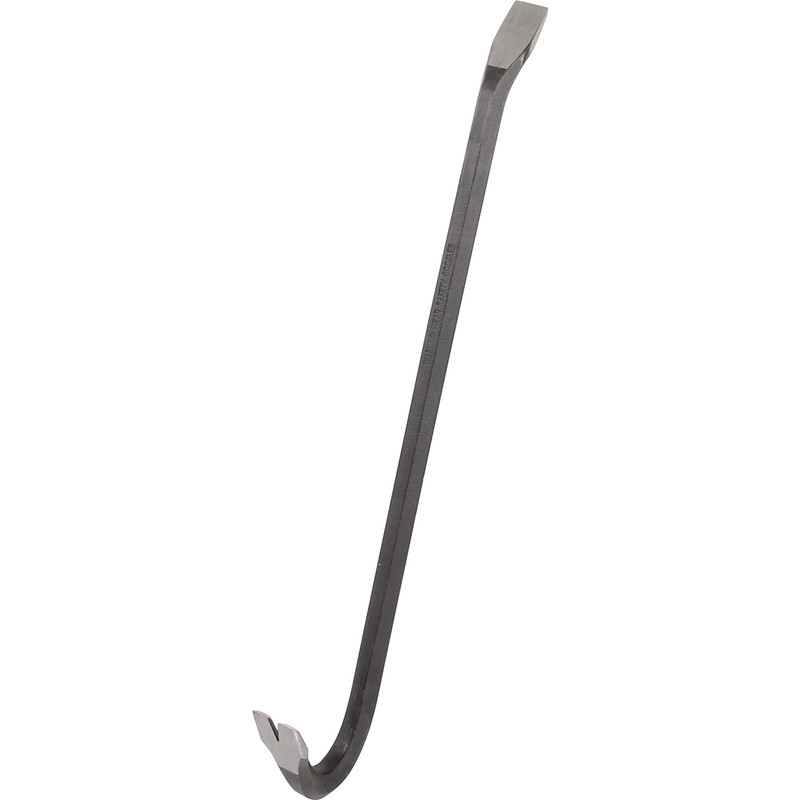
Check price on AmazonRoughneck 64-418 Wrecking Bar
Best traditional gooseneck at a fair trade price
This is the classic gooseneck shape most people picture when they hear “crowbar” — a hexagonal-section bar, drop-forged and heat-treated, with a curved claw at one end and a flat chisel point at the other. At 450mm it has enough reach to get behind a stubborn skirting board or lever a sash window bead without the shorter leverage of a 12in bar, while still fitting in a tool bag rather than needing dedicated van space.
It doesn’t carry the purpose-shaped, low-profile claws of the Gorilla bar above, so it’s a slightly blunter instrument on a delicate first lift under a board — better suited to general prying and demolition once something is already partly open.
For
- Drop-forged and heat-treated rather than cast
- Useful mid-length reach for skirting and general prying
- Keenly priced for a proper hex-section bar
Against
- Claw shape is more general-purpose than board-specific
- No integrated nail-puller notch
Typically £8–£12
Check price on AmazonFaithfull FAIWB18 Wrecking Bar

Best solid trade-brand budget pick
Faithfull is a long-standing UK trade brand rather than an anonymous import, and this bar reflects it: octagonal-section steel, hardened and tempered at both the chisel and claw ends, at a price close to the cheapest bar on this list. It’s a sensible second bar to leave in the van for the days the main one is in use elsewhere, or so two people can work a stuck board from both ends at once.
There’s no standout feature that separates it from the Roughneck 64-418 at a similar price and length — it’s a solid, unremarkable bar from a brand with a genuine trade track record, which is precisely the point.
For
- Recognised UK trade brand rather than an unbranded import
- Hardened and tempered at both working ends
- A fair length for general skirting and floorboard work
Against
- No standout feature over the Roughneck 64-418 at a similar price
- Finish is functional rather than refined
Typically £8–£12
Check price on AmazonSilverline 868781 Wrecking Bar

Best on a budget — small enough for tight voids
Silverline turns up in nearly every field-kit guide on this site for the same reason it’s here: a forged, hardened tool at a price that removes any hesitation about buying a second one. At 300mm it’s the shortest bar in this list, which is a genuine advantage getting into a shallow void or a tight stud cavity where an 18in bar simply won’t fit, rather than a compromise on a bar that’s just cheaper.
The trade-off is leverage — on anything genuinely stuck, the shorter length gives you noticeably less mechanical advantage than the bars above. As a compact bar to keep alongside a longer one rather than instead of it, it earns its place.
For
- Cheapest bar on this list
- Short enough for confined voids and stud cavities
- Forged hexagonal steel rather than cast
Against
- Limited leverage on anything genuinely stuck
- Smaller claw than the longer bars here
Typically £5–£9
Check price on AmazonWhat actually matters — and what doesn’t
“Forged” is a claim worth checking, not assuming. Drop-forged steel is worked under pressure into a dense, consistent piece; cast steel is poured into a mould and can carry internal voids invisible until the bar snaps or bends under load. If a listing doesn’t name the process, treat it as cast and price it accordingly — the cheapest bars on this list that do name “drop-forged” are still doing more for the money than an unlabelled import at the same price.
Tip thickness and taper over headline steel grade. A listing quoting a specific carbon-steel grade or tensile figure isn’t obviously better if the working edge in the product photos is ground thick and blunt. Look at the taper before the spec sheet — that’s what actually determines whether the bar bites cleanly under a board or bounces off.
Size matched to real jobs, not the biggest bar available. Most survey-related use is a first careful lift, not full demolition. A 12–18in bar covers the great majority of what comes up on an inspection; a 3ft-plus bar is a two-handed, both-feet-planted tool for masonry and lintels, and awkward to half-draw in a loft.
Permission and reinstatement, not the bar itself. What actually protects a report and a client relationship is asking before lifting anything structural or decorative, and being able to put it back afterwards. A line in the report — “floorboard lifted with the owner’s consent to inspect the joist below” — covers far more than any amount of extra spend on the tool that lifted it.
What the marketing pushes that you can skip. Paint colour, branded pouches and “heavy-duty” printed on a thin, unground edge are all decoration. None of it changes whether the taper bites cleanly or the steel bends first time you lean on it.
Questions I get asked
What’s the difference between a crowbar, a wrecking bar and a pry bar? In practice the names overlap heavily and manufacturers use them almost interchangeably. Where there is a distinction, “crowbar” and “wrecking bar” tend to describe a heavier, hexagonal or round-section bar built for demolition and general levering, while “pry bar” more often describes a flatter, thinner-bladed tool — like the Stanley Wonder Bar above — intended for delicate trim and nail work. Buy on the shape and taper of the working end, not the name on the listing.
What size crowbar do I need to lift a floorboard? For a single board in a domestic suspended timber floor, something in the 12–18in range with a thin, tapered end is usually enough — long enough for real leverage over a joist, short enough to work in a confined loft or stair void. Anything past about 24in is more leverage than most floorboard work needs, and becomes awkward to manoeuvre in a tight space.
Will a crowbar damage floorboards or skirting? Any bar can, if it’s the wrong shape or forced into the wrong place. A thin, properly ground taper worked gently into an existing joint — the tongue-and-groove edge of a board, or the gap behind a skirting board — does far less damage than a thick wedge hammered under the middle of a board. Where a floor covering or fitted skirting will be visibly marked, that’s worth flagging to the owner before lifting it, not just noting afterwards.
Is a drop-forged crowbar actually stronger than a cast one? Yes, meaningfully. Forging works the steel under pressure into a denser, more consistent grain structure, while casting pours molten steel into a mould and can leave internal voids that stay invisible until the bar fails under load — typically as a snapped tip or a bent shaft at exactly the moment you’re leaning on it. It’s the single biggest factor separating a bar that lasts years from one that doesn’t survive its first genuinely stuck board.
A crowbar rarely justifies its own line in an instruction, but the moment it comes out is often the moment a survey earns its fee — the difference between “floor covering prevented inspection” and an actual answer about the joists underneath. If that’s turning into a bigger question about a building survey or what’s really going on with a suspended timber floor as part of a PAS 2035 retrofit assessment, get in touch. And if you’re building out the rest of the bag, there are more field-kit guides.
Small print. This guide is general information, not a recommendation to carry out invasive inspection without the owner’s consent or appropriate care. Prices are indicative, move constantly and are checked at the time of writing; the linked page always shows the current price. As an Amazon Associate I earn from qualifying purchases.