An air brick is the grille set into an external wall that lets outside air reach the void under a suspended timber ground floor — the gap between the earth and the underside of the joists. That void needs to stay dry and moving, because timber sitting over still, humid air is exactly the condition wet rot and dry rot need to get started. The air brick isn't decorative and it isn't optional: it's the only thing keeping that void ventilated once the floor's been laid, and on most pre-1980s houses it's the entire strategy for keeping the joists alive.
What actually goes wrong is rarely the air brick itself failing. It's almost always something done to the wall around it, years after the house was built: a driveway or patio raised to meet a new door threshold and left covering half the brick; cavity wall insulation blown in without a vent sleeve fitted through it, silting the airway shut; a repaint or render job that skims straight over the grille because nobody thought to mask it; flower beds banked up against the wall. None of these are dramatic events. They're all small, well-intentioned bits of work that happen to switch off the ventilation without anyone noticing for years, and by the time it shows up as a bouncy floor or a musty smell it's a joist-replacement job, not a vent-swap job.
Where I do find rot or persistent damp at floor level and the sub-floor void turns out to be the cause, the honest next step is usually a proper look with a borescope through the floor before anything gets lifted — a borescope tells you how far the damage has spread without taking the floor up speculatively. If what's driving the problem is rising damp in the wall itself rather than a blocked void, that's a different job entirely; rising damp treatment costs covers what that actually involves and when it's genuinely needed rather than oversold. And if you're trying to work out what a defect note on your own survey report actually means for your wallet, survey defect costs puts rough figures against the common ones, air bricks and sub-floor ventilation included. With that context, here's the vent I'd fit first when an original air brick has been lost or built over.
The one I’d buy

Manthorpe G960 Telescopic Underfloor Vent with Terracotta Airbrick
Manthorpe is one of the two names (with Timloc) that turn up across most UK housebuilding, and the G960 is its retrofit answer to the single most common problem on site: the airway between the outer airbrick and the sub-floor void isn't a fixed length. The telescopic sleeve extends to suit anywhere from three to seven brick courses of cavity depth, a vermin grille is built in, and the terracotta face matches most reclaimed and modern clay brickwork without standing out. It's the vent to reach for when an original air brick has gone missing, been built over, or simply doesn't line up with where the void actually is.
Typically £20–£28
Check price on AmazonHow I judge an air brick or vent cover
Equivalent free area against what the void actually needs, not just a like-for-like swap with whatever was there. Approved Document C's long-standing guidance, carried through NHBC technical standards and every major manufacturer's own literature, asks for at least 1,500mm² of ventilation per metre run of external wall or 500mm² per m² of floor area — whichever is greater — on at least two opposite external walls.
Telescopic adjustment range, so the vent reaches from the outer wall face to the actual sub-floor void without needing the brickwork re-cut. Cavity depths and brick courses vary more between houses than most people expect.
A built-in vermin grille, or a separate cover fitted over the top. An open airbrick is an open invitation to mice; a cover that clogs with debris just moves the blockage problem rather than solving it.
Material and finish matching the wall — clay-effect terracotta and buff read as brick, black and white plastic read as a retrofit, and on a period property or anywhere the front elevation is visible that distinction matters more than it should.
Whether the job needs an accessory, not just a bigger vent. A raised path or a deep cavity isn't fixed by a longer straight sleeve on its own — see the section below on periscope vents and when a plain telescopic vent genuinely isn't the answer.
The comparison
| Model | Type | Equivalent area | Typical price | Best for | |
|---|---|---|---|---|---|
| Manthorpe G960 + terracotta airbrick | Telescopic, 3–7 courses | 6,600mm² | ~£20–£28 | Best all-round retrofit vent | View |
| Timloc Telescopic + black airbrick | Telescopic, 3–5 courses | 6,000mm² | ~£9–£13 | Trade alternative to Manthorpe | View |
| Manthorpe G930 Airbrick (Buff) | Plain surface-mounted | 6,450mm² | ~£5–£8 | Simple like-for-like swap | View |
| Manthorpe G962 Remote Void Sleeve | Extension accessory | Routes existing area | ~£13–£18 | Routing round a raised path or patio | View |
| 10 x Grey Air Bricks | Plain surface-mounted, pack | 6,170mm² each | ~£10–£14 per pack | Cheapest for a whole elevation | View |
| Mousemesh Medium Brown cover | Vermin-proofing cover | 180×255mm | ~£14–£18 | Pest-proofing an existing airbrick | View |
| The Mesh Company rodent mesh sheet | Cut-to-size mesh | 2 × 300×210mm sheets | ~£8–£11 | Budget, irregular vent openings | View |
The picks in detail
Manthorpe G960 Telescopic Underfloor Vent with Terracotta Airbrick
Best all-round retrofit vent — adjusts to fit almost any cavity depth
The core problem with retrofitting an air brick is rarely the grille itself, it's the distance between the outer wall face and the actual sub-floor void, which varies with cavity width, wall thickness and how the original brickwork was laid. The G960's telescopic sleeve extends across three to seven brick courses to close that gap without cutting anything, gives 6,600mm² of equivalent area with the vermin grille fitted, and the terracotta airbrick face reads as brick rather than as an obvious plastic retrofit. It's the vent I'd reach for first when an original has gone missing or been built over and there's no way to know the exact depth until you're on site.
For
- Telescopic 3–7 course range covers most retrofit situations
- 6,600mm² equivalent area, above the smaller alternatives here
- Terracotta face matches clay brickwork better than plain plastic
Against
- Priciest single vent in this list
- Still a straight-through sleeve — doesn't solve a raised-ground obstruction on its own
Typically £20–£28
Check price on AmazonTimloc Telescopic Underfloor Cavity Vent with Black Airbrick
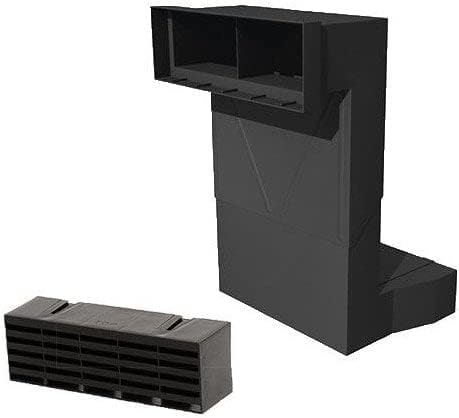
Best trade alternative — the other name specified alongside Manthorpe
Timloc is the other big fabricator-specified name in sub-floor ventilation, and this is its direct equivalent to the G960: a telescopic sleeve adjustable across three to five brick courses, 6,000mm² equivalent area, a vermin grille built in, and manufactured to meet NHBC Standards and current Building Regulations. It costs meaningfully less than the Manthorpe unit for a slightly shorter adjustment range, which makes it the sensible pick where the black airbrick finish suits the wall and the extra two courses of reach aren't needed.
For
- Roughly half the price of the top pick for a comparable spec
- NHBC Standards compliant, a name most trades recognise
- Black finish suits darker brick or render
Against
- Shorter 3–5 course adjustment range than the Manthorpe unit
- 600mm² less equivalent area
Typically £9–£13
Check price on AmazonManthorpe G930 Airbrick 9×3in (Buff)

Simple like-for-like swap — when the depth already lines up
Not every airbrick replacement needs the telescopic complexity above. Where the existing opening already goes straight through to the void at the standard depth, the G930 is a plain surface-mounted airbrick with front-mounted water deflectors, a mortar key round the edge for a secure fix, and a clip-together design that lets two or three units combine into a 9×6 or 9×9 opening. 6,450mm² of equivalent area per single unit, suitable for use near gas appliance flues, and the buff colour is the closest plastic match to a lot of London stock brick.
For
- Cheapest single vent that still carries a published area figure
- Clips together for larger 9×6 and 9×9 openings
- Water deflectors built into the grille
Against
- Not telescopic — needs the depth to already be right
- No vermin mesh beyond the grille slots themselves
Typically £5–£8
Check price on AmazonManthorpe G962 Remote Void Sleeve

Premium/professional pick — routes air past a raised path or patio
This is the accessory to reach for once a straight telescopic vent genuinely can't reach, which is more common than it should be: a patio laid up to the wall, a ramped threshold, or an extension slab that's buried the original airbrick position. The G962 steps the airway 150mm vertically or 185mm rearward from the back of a telescopic vent like the G960, carrying ventilation round the obstruction to a void that's still there but no longer reachable in a straight line. It's a trade-grade fix, not a full periscope reinstall, and it's the honest retrofit answer more often than tearing up the patio is.
For
- Solves the raised-ground problem without lifting paving
- Pairs directly with the G960 telescopic vent above
- Genuine Manthorpe part, not a generic clone
Against
- An accessory, not a standalone vent — needs a telescopic unit to pair with
- Priced closer to a full vent than a simple fitting
Typically £13–£18
Check price on Amazon10 x Grey Air Bricks, 9×3 Brick Grille

Budget pick — cheapest when a whole elevation needs replacing
Where the job is replacing every airbrick along a wall run rather than one, buying a pack works out considerably cheaper than ten single units. This is a plain grey injection-moulded grille, 6,170mm² equivalent area printed on the unit itself, no telescopic sleeve and no branded vermin mesh beyond the grille slots — a straightforward like-for-like replacement rather than a solution to a depth or obstruction problem. Grey suits a rendered or painted elevation better than it suits exposed brick.
For
- Cheapest equivalent area per unit of anything here
- Sensible where several airbricks along one wall need replacing together
- Published 6,170mm² area printed on the moulding
Against
- Generic, unbranded — no manufacturer technical datasheet to point to
- Grey plastic, not a convincing brick match on an exposed elevation
Typically £10–£14 for the pack of 10
Check price on AmazonMousemesh Medium Brown Pest Proofing Air Brick Vent Cover

Best for an existing airbrick that mice keep getting into
Some of the airbricks I see haven't failed structurally at all, they've just stopped keeping vermin out — a slotted plastic grille alone has gaps a mouse fits through easily. Mousemesh fits over the existing airbrick face as a framed cover, 180×255mm to suit a standard 9×3 opening, with a fine woven mesh that keeps the pest-proofing without closing the airway down to nothing. It's a genuinely useful retrofit where the vent itself is fine and the problem is specifically what's getting in through it, and the brown finish is the closest colour match of the covers here to a clay airbrick.
For
- Fits directly over an existing 9×3 airbrick, no vent replacement needed
- Fine woven mesh genuinely stops rodents rather than just slowing them
- Brown finish suits a clay airbrick better than the budget mesh sheet
Against
- Pricier than the cut-to-size mesh sheet below for a smaller area
- Fixed size — doesn't suit an irregular or oversized opening
Typically £14–£18
Check price on AmazonThe Mesh Company Airbrick Vent Cover Rodent Mesh Sheet

Cheapest pest-proofing, and the only one that fits an odd-sized opening
Two flat A4-sized (300×210mm) sheets of woven stainless steel mesh, sold uncut and unframed, cut to shape with scissors or tin snips and fixed with construction adhesive or screws. Where Mousemesh above is a neat fit for a standard opening, this is the answer for an airbrick that's an odd size, damaged around the edge, or one of a batch that needs covering cheaply across a whole elevation. Stainless steel doesn't rust the way a cheaper woven mesh will after a few UK winters.
For
- Cheapest pest-proofing option here, and covers two openings
- Cuts to fit any shape or size of vent
- Stainless steel, won't rust like plain steel mesh
Against
- No frame — needs cutting and fixing properly to look tidy
- No colour options, plain metallic finish only
Typically £8–£11
Check price on AmazonTelescopic vents, periscope vents, and when a straight-through vent isn't enough
Every product above except the G962 accessory is a straight-through vent: air travels in a more or less direct line from the outer wall face to the sub-floor void, telescopic or not. That works for most houses. It doesn't work where the ground outside has been raised above the original airbrick line, which is common on older terraces where a road, pavement or patio has crept upward over decades of resurfacing — Georgian and Victorian properties fronting a public highway are particularly prone to it. Forcing a straight vent through in that situation either sits it below finished ground level, where surface water runs straight into the void, or leaves it uselessly high above where the void actually is.
That's the job a genuine periscope vent is built for: a Z-shaped or stepped duct that takes air in at a usable height above the raised ground and routes it down and across to the void, rather than running in a straight line. Rytons and Cast Iron Air Bricks both make dedicated periscope units for exactly this scenario, specified through builders' merchants and installers rather than sold as a fixed-price retail SKU I could verify in stock on Amazon at the time of writing — which is why there's no periscope vent with a buy button in this guide. The G962 remote void sleeve above is the closest thing to a periscope fix available as a straightforward online purchase: it won't clear a full raised-ground scenario on its own, but it handles the more common case of a path or slab that's crept over one side of the opening.
What actually matters — and what doesn’t
A blocked air brick is rarely deliberate. Nobody sets out to seal a sub-floor void. It happens one render job, one raised patio and one flower bed at a time, which is exactly why it's worth a five-minute check from outside before assuming the floor itself is at fault.
Painting over the grille is worse than it looks. A coat of masonry paint that bridges the slots can cut the free area to almost nothing while leaving the airbrick looking untouched from a distance — it's one of the quicker checks on a survey precisely because it's so easy to miss from the pavement.
More air bricks isn't automatically the fix if the total area is already there. The guidance figure is a total equivalent area across at least two opposite walls, not a rule that every wall needs its own vent regardless of size.
Cavity wall insulation and air bricks need to be specified together. A cavity that's had insulation blown in without a vent sleeve fitted through it can silt the airway shut from the inside, invisibly, which is one of the less obvious things worth asking an installer about before work starts.
On a listed building or in a conservation area, swapping a clay airbrick for plastic is a visible change. It's a small alteration but exactly the kind a conservation officer can have a view on for a front elevation. Check before assuming a like-for-like plastic swap is uncontentious.
Questions I get asked
Can I just block up an air brick I don't like the look of? No — permanently sealing one reduces the total ventilated area below what the void needs, and on an older suspended timber floor that's a direct route to wet or dry rot. If it's the appearance rather than the airflow that bothers you, a colour-matched cover or a smaller, better-placed vent is the fix, not sealing it.
What do I do if the outside ground level has been raised above my air bricks? That's exactly the situation a periscope vent is designed for — see the section above. Don't force a standard telescopic vent through at the wrong height; get a periscope unit specified through a merchant or installer instead.
Do I need Building Regulations approval to add or move an air brick? Straightforward like-for-like replacement generally doesn't need sign-off. Adding new sub-floor ventilation, or altering it as part of other works, falls under Approved Document C and is worth raising with your local authority or a competent-persons-scheme installer rather than guessing.
How do I know if my sub-floor void has enough ventilation? Count the airbricks, estimate their equivalent area from the manufacturer's figures, and check it against 1,500mm² per metre run of wall (or 500mm² per m² of floor area, whichever is greater) across at least two opposite walls. If that doesn't add up, or you can't tell because some vents are hidden behind planting or paving, that's a reasonable thing to flag on a survey.
I don’t fit air bricks or ventilation myself, but if a bouncy floor, a musty smell or visible rot at floor level is what's brought you here, a building survey traces the cause properly before anything gets lifted, and a borescope is often the first practical step. If rising damp in the wall itself looks more likely than a blocked void, rising damp treatment costs sets out what that job actually involves, and survey defect costs gives a general steer on what a defect note like this tends to cost to put right. Get in touch for a second opinion, and there are more field-kit guides to work through.
Small print. This guide is general information, not a ventilation calculation for your specific property — get that checked properly, especially on a listed building or in a conservation area where an alteration may need consent. Prices are indicative, move constantly and are checked at the time of writing; the linked page always shows the current price. As an Amazon Associate I earn from qualifying purchases.