The Association of British Insurers puts the figure at around £1.8 million a day paid out on escape-of-water claims, and reckons nearly one in five claims on buildings and contents insurance is for leak damage. A weather-related burst pipe alone averaged over £10,000 to put right. None of that is exotic risk — it's a washing machine hose, a compression joint under a sink, or a stopcock nobody in the house has ever turned. Water finds the cheapest way down through a ceiling and keeps going until something stops it, usually long after it started.
That's the gap these products fill, and it's worth being clear about which job each one does. A leak sensor is a smoke alarm for water: it tells you something is wrong, loudly, and if a phone's involved, from wherever you are. It does nothing to stop the leak. Only an automatic shut-off valve does that, cutting the supply the moment it sees a problem, whether anyone's home or not. Both have a place — a sensor costs less than a round of drinks, a shut-off valve costs more than most will spend, but is the only thing here that prevents the claim rather than just reporting it faster.
Where this connects to survey work: several escape-of-water claims I hear about trace back to a stopcock nobody could find in time, or one so seized it needed a wrench and both hands while the ceiling came down. If a house survey turns up old or inaccessible stopcocks, that's worth fixing before adding a sensor on top of it.
The one I’d buy
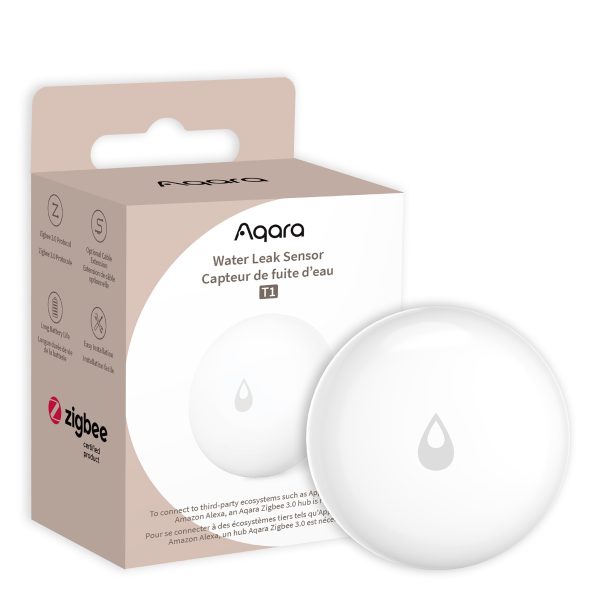
Aqara Water Leak Sensor T1
Cheap enough to buy four or five and put one under every real risk — washing machine, dishwasher, boiler, cold water tank, under the kitchen sink — rather than a single sensor covering one spot and hoping. It works across HomeKit, Alexa, Google Home and SmartThings via an Aqara hub, and the battery is rated for around two years.
Typically £17–£20 each
Check price on AmazonHow I judge a water leak detector
What it can actually see. A point sensor only knows about water where its own probe or pads sit — it says nothing about the rest of the house. A whole-house system fitted to the mains sees every drop passing through, which is a fundamentally bigger job than watching one appliance.
Alert versus shut-off. This is the real dividing line. An alarm is only useful if a person hears it and can act — fine for a leak under the kitchen sink while you're in the next room, less useful for the immersion tank while you're on holiday. An automatic shut-off valve acts on its own, which matters most for the leaks nobody's around to hear.
Whether it depends on a hub. Several sensors here only talk to a separate hub rather than wifi directly, which is one more box that needs power and a network connection to keep working, and one more thing to check after a power cut.
Alarm volume and battery life, not app polish. A dashboard with pretty graphs is worth nothing if the siren can't be heard two rooms away, or the battery's been flat for a month without anyone noticing. The plain, dumb alarm that's simply loud is doing its one job properly.
Whether there's a working stopcock to shut anyway. An automatic valve is only as good as the pipework it's fitted to. In an older property with a seized or inaccessible stopcock, that's the thing to sort first.
The comparison
| Model | Type | Needs a hub | Typical price | Best for | |
|---|---|---|---|---|---|
| Aqara Water Leak Sensor T1 | Point alert | Yes — Aqara hub | ~£17–£20 | Buying several, widest ecosystem support | View |
| TP-Link Tapo T300 | Point alert | Yes — Tapo Hub H100 | ~£15–£20 | Households already on the Tapo ecosystem | View |
| GuDoQi Water Leak Detector | Point alert, siren only | No | ~£12–£18 | No smart home, no subscription, no app | View |
| Grohe Sense | Point alert + climate log | No — direct wifi | ~£65–£95 | One clean sensor with humidity/temperature history | View |
| Aqara Smart Valve Controller T1 | Automatic shut-off | Yes — Aqara hub | ~£60–£75 | Affordable shut-off retrofitted to an existing stopcock | View |
| Grohe Sense Guard | Whole-house monitor + automatic shut-off | No — direct wifi, professional install | ~£430–£550 | Whole-house protection, insurer discount schemes | View |
The picks in detail
Aqara Water Leak Sensor T1
Best overall — cheap enough to cover every appliance, and my top pick above
A small IP67 puck that sits flat on the floor and reacts to water touching its underside, reporting over Zigbee 3.0 to an Aqara hub and from there to HomeKit, Amazon Alexa, Google Home or SmartThings. Because it costs about the same as a takeaway, the sensible move is buying several rather than one — under the washing machine, the dishwasher, the boiler, the cold water tank in the loft, wherever a slow leak would otherwise go unnoticed for weeks.
The catch is the hub: without one already in the house, that's an extra piece of kit and cost on top of the sensor itself, and the whole system stops reporting if the hub loses power or wifi. The CR2032 coin battery is rated for around two years, which is long enough that it's worth a note in the calendar to check it rather than relying on memory.
For
- Cheap enough to buy several and cover every appliance
- Works with HomeKit, Alexa, Google Home and SmartThings
- IP67 rated, roughly two-year coin cell battery life
Against
- Needs an Aqara hub to do anything beyond a local beep
- Alert-only — it reports a leak, it doesn't stop one
Typically £17–£20 each
Check price on AmazonTP-Link Tapo T300
Best for a household already on Tapo — plugs straight into an existing ecosystem
Functionally close to the Aqara sensor — an IP66 puck with top and bottom probes reporting a leak to a phone — but built around TP-Link's own Tapo Hub H100 rather than Zigbee generally. For a house that already has Tapo cameras, plugs or a hub from another product, adding a leak sensor onto the same app and hub is the path of least resistance. The alarm itself claims up to 90 decibels, loud enough to hear from an adjoining room.
It works with Alexa and Google Assistant but not HomeKit, which matters if the rest of the house runs on Apple's ecosystem. Two AAA batteries are rated for roughly one to two years, on the shorter side of this comparison.
For
- Straightforward if a Tapo hub is already in the house
- 90dB alarm, loud enough for an adjoining room
- Dual top/bottom probes
Against
- No HomeKit support
- Needs the separate Tapo Hub H100
- Battery life shorter than the Aqara equivalent
Typically £15–£20 each
Check price on AmazonGuDoQi Water Leak Detector
Best budget pick — no app, no hub, no subscription, just a loud siren
For anyone who doesn't want a smart home ecosystem at all, this is the entire category boiled down to its essentials: a battery-powered puck with a 100cm probe cable, sounding a claimed 130dB siren the instant the probe touches water. There's no wifi, no app, no hub and no ongoing cost of any kind — it sits under the sink or behind the washing machine and does one job.
That simplicity is also the limit. It can't tell a phone anything while you're out, so it only helps if someone's in the house and within earshot when it goes off. For a cellar, a garage, or a spot with a genuinely low but non-zero risk, a couple of these are a sensible, cheap first line rather than the whole answer.
For
- No app, hub or subscription of any kind
- Claimed 130dB siren, hard to miss if home
- Genuinely cheap, easy to buy several
Against
- No remote alert — useless while out of the house
- No history or logging, just a siren
Typically £12–£18
Check price on AmazonGrohe Sense
Best standalone smart sensor — no hub, with temperature and humidity logging on top
Grohe's own sensor talks to wifi directly rather than leaning on a separate hub, which removes one point of failure compared with the Aqara and Tapo sensors above. Alongside leak detection it logs temperature and humidity continuously through the Ondus app, which can be a useful early warning for a damp or condensation problem developing in the same spot a leak would otherwise be watched for.
It costs three to four times what a basic point sensor does for the same core job — detecting water on the floor beneath it — and the premium is really paying for the no-hub convenience and the climate logging rather than a materially better leak detector. Worth it for one well-placed sensor in an awkward spot; harder to justify buying several of at this price.
For
- Direct wifi — no separate hub needed
- Continuous temperature and humidity logging
- Around four years of battery life claimed
Against
- Expensive for a single point sensor
- Alert-only, same as the cheaper options
Typically £65–£95
Check price on AmazonAqara Smart Valve Controller T1
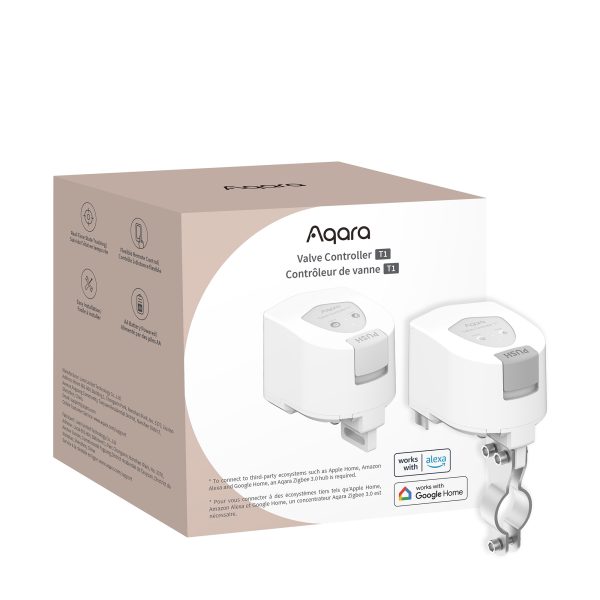
Best affordable automatic shut-off — clamps onto an existing stopcock, no plumbing required
Rather than replacing a section of pipe, this clamps onto the lever or handle of an existing stopcock and turns it under motor power — no plumber, no cutting into the supply. Paired with an Aqara leak sensor in the same app, an automation can close the valve the moment a leak's detected, turning an alert-only sensor into something that actually stops water, for a fraction of a dedicated whole-house system's price.
It only works on stopcocks it can physically clamp onto, so an old or awkward valve may not suit it, and it depends on the same hub and wifi as the sensors. Still, for anyone put off an automatic shut-off by the cost of professional installation, this is the honest middle ground.
For
- No plumbing or professional install — clamps onto the existing stopcock
- Automates with Aqara leak sensors for real shut-off, not just an alert
- Far cheaper than a dedicated whole-house valve system
Against
- Needs a stopcock lever or handle it can physically clamp to
- Depends on the same hub and wifi as the sensors
Typically £60–£75
Check price on AmazonGrohe Sense Guard
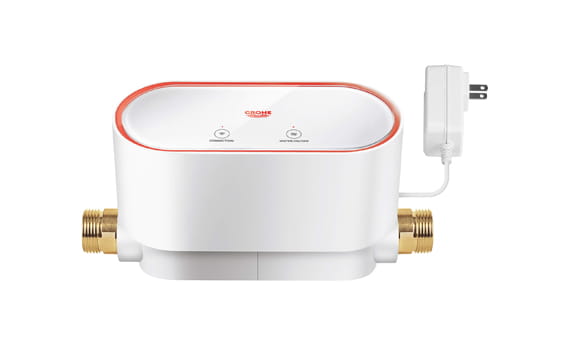
Best professional whole-house system — the one that genuinely prevents the £10,000 claim
This fits into the mains supply itself, professionally, and monitors pressure, flow and temperature around the clock rather than watching one spot on a floor. Grohe's AquaIQ software learns the house's normal usage pattern and flags anything outside it, then closes the built-in valve automatically if the flow looks like a leak rather than someone filling a bath.
The install is the real cost: a plumber's job into the incoming main, not a DIY afternoon. Some UK insurers, including Hiscox, now supply a leak-detection device free to policyholders or reduce the excess on escape-of-water claims while one is fitted, worth checking before assuming the sticker price is the whole cost. For a high-value or hard-to-monitor property, it's the one product here that stops the flood rather than just reporting it.
For
- Monitors the whole house, not one spot
- Closes the mains supply automatically on a detected leak
- Some insurers offer discounts or reduced excess for fitting one
Against
- Professional plumbing install required
- By far the most expensive product here
Typically £430–£550, plus professional installation
Check price on AmazonWhat actually matters — and what doesn’t
Placement beats brand. A single expensive sensor in the wrong spot does less than three cheap ones under the appliances that actually fail: washing machine, dishwasher, boiler, and any cold water tank in the loft. Cover the risk before upgrading the hardware.
An alert only works if someone's there to act on it. A phone notification while at work still means water running for hours before anyone gets home. That's the entire case for an automatic shut-off valve over a sensor, for anyone who's out of the house more than they're in it.
Check the stopcock before buying an automatic valve. A shut-off system, smart or otherwise, is only as good as the plumbing it's fitted to. A stopcock that's seized, buried, or simply unknown to the household needs sorting on its own merits regardless of what gets bolted onto it.
"Works with Alexa" is a smaller deal than it sounds. Voice integration is a nice-to-have; a loud, reliable local siren that works even if the wifi is down is the feature that actually matters when nobody's looking at an app.
A hub is one more thing that can fail. Any sensor that depends on a separate hub stops reporting if that hub loses power, wifi, or simply gets unplugged and forgotten in a house move. Standalone, direct-wifi sensors and dumb, hub-free alarms don't have that extra failure point.
Questions I get asked
Will a leak detector actually reduce my home insurance premium? Sometimes, though it's the exception rather than the rule. Hiscox has supplied a free leak-detection device to buildings-insurance customers, and some insurers reduce the excess on escape-of-water claims while a recognised device is fitted. It's worth asking an insurer directly rather than assuming, since the discount schemes that exist aren't universal or automatic.
Do I need a smart home hub for these to work? Only for the Aqara and Tapo point sensors. Grohe's Sense connects to wifi directly, the GuDoQi-style budget alarm needs nothing beyond its own battery, and the whole-house systems have their own built-in connectivity. A hub is convenient if several sensors already share one, but it isn't a requirement across the category.
What's the real difference between a leak alarm and an automatic shut-off valve? An alarm tells you, loudly or via a phone notification, that water is where it shouldn't be. It does nothing else. A shut-off valve, whether a retrofit clamp on an existing stopcock or a professionally installed mains unit, physically stops the water itself, whether or not anyone's home to hear the alert.
Where should sensors actually go? Under the washing machine and dishwasher, behind or under the boiler, under any cold water tank in the loft, under the kitchen sink where the supply pipes and waste connect, and near an unvented cylinder if there is one. Those are the points that fail most often, well ahead of anywhere more exotic.
A sensor or a shut-off valve only ever answers the question of what happens after something starts leaking — if a house survey or full building survey turns up old pipework, a corroded cylinder or a stopcock that doesn't work, that's the thing worth fixing first. Get in touch for a second opinion on a property before or after buying, and there are more field-kit guides covering the rest of what's worth having in the house.
Small print. This guide is general information, not an assessment of your own property or plumbing; any work on a mains water supply, including fitting an automatic shut-off valve, should be carried out by a competent, registered plumber. Prices are indicative, move constantly and are checked at the time of writing; the linked page always shows the current price. As an Amazon Associate I earn from qualifying purchases.