Most survey work doesn’t need much kit, but it needs the same handful of things every single day — a damp meter, a laser measure, a torch, a tablet, sample bags, and whatever’s been picked up for that afternoon’s job. Left loose, all of it migrates to the bulkhead within a week and stays there, which is exactly the kind of thing that turns a five-minute pull-up outside a job into a ten-minute rummage. Racking fixes that by giving everything a shelf it lives on, not a corner it happens to end up in.
It also matters for reasons that have nothing to do with tidiness. An unsecured tool box or a loose stack of crates becomes a genuine hazard under hard braking, which is why the racking worth buying is bolted through into the van’s floor or wall structure, not wedged in and left to find its own level. Before any brand comes into it, the two real decisions are the material — steel, aluminium or plywood — and whether the fit is universal or cut for one van.
What follows is what actually matters when buying van racking, and seven systems worth fitting — from a universal aluminium unit through divided steel bins to plywood cut for a specific van.
The one I’d buy

Van Guard TVR-102 Trade Van Racking Triple Angled Shelf
Sold under Van Guard’s own Trade Van Racking (TVR) line — the badge is stamped into the aluminium end panel — this is a universal three-shelf unit that fits across most SWB and LWB panel vans rather than one named model, which matters if the van ever gets swapped or replaced with a different make. The top shelf angles backward to stop a tool case sliding forward under braking, the whole thing is aluminium rather than steel so it doesn’t eat into payload the way a comparable steel unit would, and it’s sold as crash-tested rather than just built to look sturdy.
Typically £320–£360
Check price on AmazonHow I judge van racking
Fixing method and crash safety before anything else. A racking system is only as good as what it’s bolted into — look for fixings that go through into structural floor or wall points, not self-tappers into thin door skin, and prefer a manufacturer that states its unit has been crash-tested rather than just described as heavy-duty.
Material is a genuine trade-off, not a quality ranking. Steel is the toughest and usually the cheapest per shelf, aluminium keeps weight down without giving up much rigidity, and plywood is the cheapest to buy outright and the easiest to modify on site — but it needs to stay dry, and it eventually delaminates if the van leaks.
Universal fit against vehicle-specific fit. A universal bracket kit adapts to several van models and moves with the business if the van changes; a kit cut for one exact model — a Transit Custom SWB offside, say — uses the space far more tightly but is tied to that van for as long as it’s owned.
Weight against the van’s payload plate. A loaded steel racking run can weigh 40–80kg before a single tool goes on it, which is worth weighing against what’s already eaten into payload from ply lining, a bulkhead and a roof rack on a 3.5t panel van.
Self-build against delivered assembled. Flat-pack kits are cheaper and easier to trim to fit an odd corner; assembled units cost more but save a weekend and arrive square.
The comparison
| Model | Material | Fit | Typical price | Best for | |
|---|---|---|---|---|---|
| Van Guard TVR-102 | Aluminium | Universal | ~£340 | Best overall | View |
| Autorack StoreTidy | Steel | Universal | ~£260 | Best divided steel bins | View |
| Autorack Modular Steel | Steel | Universal, expandable | ~£200 | Best budget starter unit | View |
| Autorack 3-Unit Package | Steel | Universal | ~£790 | Best full one-side fit-out | View |
| Monster Racking Transit Custom | 12mm plywood | Transit Custom SWB/LWB | ~£235 | Best for a Transit Custom | View |
| Monster Racking SWB 4-Shelf | 12mm plywood | Universal SWB | ~£125 | Best on a budget | View |
| Plyline NorthEast Transporter | 12mm plywood | VW Transporter T5/T6 SWB | ~£350 | Best ready-assembled | View |
The picks in detail
Van Guard TVR-102 Trade Van Racking Triple Angled Shelf
Best overall — the one I’d buy, above
Sold under Van Guard’s own Trade Van Racking (TVR) line, badged as such on the aluminium end panel, and built as a universal three-shelf unit rather than one cut for a single van model. The top shelf angles backward to stop a case sliding forward under braking, the aluminium construction keeps it noticeably lighter than a comparable steel unit, and it’s sold as crash-tested rather than simply described as sturdy. A universal bracket kit means it moves house if the van does, which the vehicle-specific plywood picks further down this list can’t.
For
- Universal fit across most SWB and LWB panel vans, not tied to one model
- Angled top shelf stops a case or box sliding forward under braking
- Aluminium keeps it lighter than an equivalent steel unit
- Sold as crash-tested, not just built to look heavy-duty
Against
- Three shelves only, so less total capacity than the bigger steel packages
- Aluminium costs more per shelf than an equivalent steel unit
Typically £320–£360
Check price on AmazonAutorack Products StoreTidy Van Racking Unit

Best divided steel bins — keeps small parts from mixing together
A UK-manufactured steel unit with three rows of removable dividers rather than plain flat shelves, which matters for anything that needs to stay properly separated — fixings, spare batteries, sample bags — rather than sliding into a heap at the back of a shelf. It’s crash-tested to the EU ECE/R17 standard, which is a genuine named standard rather than a vague marketing claim, and the universal bracket kit fits most panel van models without needing a vehicle-specific version.
For
- Removable dividers create proper small compartments, not just flat shelves
- Crash-tested to the named ECE/R17 standard
- UK manufactured with a universal bracket kit
Against
- Steel adds more weight than the aluminium pick above
- Open bins don’t hide contents the way a lidded box does
Typically £240–£280
Check price on AmazonAutorack Products Modular Steel Shelving System

Best budget starter unit — cheapest way into proper steel racking
The plainest unit on this list and the cheapest steel option here, with narrow-profile welded shelves rated to around 20kg each and no dividers included. What earns it a place is the ability to bolt a second unit on alongside it later rather than needing to buy a whole new system once the first one’s full — a reasonable way to start small on a tighter budget and expand once the van’s settled into steady work.
For
- Cheapest steel unit in this list
- Additional units can be bolted on alongside it to expand later
- Simple welded construction, straightforward to fit
Against
- No dividers included, so small parts still need boxes or crates on the shelves
- Plain finish with no visible branding
Typically £180–£220
Check price on AmazonAutorack Products 3-Unit Steel Van Racking Package

Best full one-side fit-out — the highest-capacity option here
Two racking units bolted together plus a single unit, supplied on its own plywood floor panel rather than relying on whatever’s already fitted in the van, with 8mm double-fold bin edges throughout. This is by far the most shelf space of anything covered here, closer to a full fit-out than a single racking unit, and it’s still a universal design rather than cut for one van model. It’s the biggest outlay on this list and needs proper drilling into the van’s structure, not a job to rush through in an afternoon.
For
- By far the most shelf space of anything on this list
- Includes its own plywood floor panel rather than needing one separately
- Universal fit, not tied to a single van model
Against
- The most expensive item here by some margin
- Needs proper drilling into the van’s structure, not a quick solo fit
Typically £750–£820
Check price on AmazonMonster Racking Plywood Van Racking, Ford Transit Custom SWB/LWB Offside
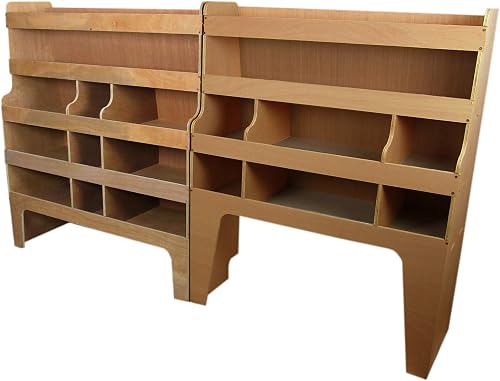
Best for a Transit Custom — a tight, purpose-cut fit
Cut specifically for the Transit Custom SWB and LWB offside rather than built to a generic footprint, which means it fits tight against the wheel arch and bulkhead without packing pieces or gaps. Twelve L-shaped fitting brackets and dividers are included in the price, and 12mm plywood is straightforward to redrill or notch on site if a bracket needs to move around a wiring loom or pipe run. The trade-off is that it’s tied to this one van and side — it doesn’t transfer to a replacement van of a different make.
For
- Cut specifically for the Transit Custom, so no gaps or packing pieces needed
- Plywood is easy to redrill or notch on site for an awkward bracket or pipe run
- Fitting brackets and dividers included in the price
Against
- Tied to one van model and side, unlike the universal steel and aluminium picks above
- Plywood adds real weight compared with a similarly sized aluminium unit
Typically £220–£250
Check price on AmazonMonster Racking Van Racking SWB Shelving Storage Unit

Best on a budget — cheapest system in this list by some distance
Four shelves, each split into four compartments for sixteen total, built from 12mm plywood and available for driver or passenger side, right- or left-hand drive. It’s the cheapest complete system covered here, with fixings included rather than sold separately, and the sixteen small compartments keep consumables and fixings properly separated without buying extra dividers. It’s a smaller footprint than the other picks, better suited to fitting alongside another unit than covering a whole side of the van on its own.
For
- Cheapest complete system in this list by a wide margin
- Sixteen compartments keep small parts separated without extra dividers
- Fixings included in the price
Against
- Smaller footprint, so it suits one section of the van rather than a full fit-out
- No weatherproof seal on any shelf edge — needs to stay dry
Typically £110–£140
Check price on AmazonPlyline NorthEast Fully Assembled Van Shelving Racking, VW Transporter T5/T6 SWB

Best ready-assembled — arrives built, not flat-packed
Cut for the VW Transporter T5/T6 SWB and built with mortise-and-tenon joints rather than screws driven into ply edge grain, which is a genuinely stronger way to join plywood and holds up better to years of vibration. It arrives fully assembled on a pallet rather than flat-packed, so there’s no build day lost to a self-assembly kit, and the slanted case sections keep taller items upright instead of sliding flat. Being pre-built means it needs two people and a clear run through the van’s doors to get it in, and like the Transit Custom pick above, it’s tied to one van model.
For
- Arrives fully assembled — no flat-pack build day required
- Mortise-and-tenon joints are a genuinely stronger build than screwed ply edges
- Slanted sections keep taller items upright rather than sliding flat
Against
- Needs two people and a clear run to fit a pre-assembled unit through the van’s doors
- Tied to the Transporter T5/T6, unlike the universal picks above
Typically £330–£370
Check price on AmazonWhat actually matters — and what doesn’t
A crash-test claim is worth more than a thick gauge of steel on its own. Genuine load-restraint testing, or a named standard like ECE/R17, is a real signal buried among a lot of spec-sheet padding — the honest question is always whether the fixings go into something structural, not how heavy the unit feels in the showroom.
A high compartment count is a marketing number, not a capacity figure. Sixteen small compartments sound generous until the thing that needs storing is a laser level case that needs one deep space, not four narrow ones — count what actually needs to fit before counting the compartments printed on the box.
Powder-coat colour and branding don’t affect how well racking works. Buy on fixing method and material, not because a unit happens to colour-match the van’s livery.
“Designed for your exact van” is a real fit benefit, not just an upsell — but only if the van’s being kept. A vehicle-specific kit uses the space more tightly than a universal one; it just doesn’t transfer to a replacement van of a different make or size, which a universal system does.
Full-height racking down both sides looks impressive but eats headroom and payload before anything’s loaded. For a surveyor’s modest kit list rather than a plumber’s stock van, a single half-height run is usually enough, with the rest of the floor left free for ladders and boxes.
Questions I get asked
Does fitting racking affect a van’s payload or its warranty? It can affect payload — a loaded steel system can weigh 40–80kg before anything’s stored on it, worth weighing against the van’s payload plate, especially if it’s already carrying ply lining and a roof rack. Warranty terms vary by manufacturer and dealer, and a leased van usually needs the leasing company’s sign-off before anything’s permanently bolted in — check both before drilling.
Should I buy a universal system or one cut for my exact van? It comes down to how long the van’s being kept. A vehicle-specific kit fits tighter and uses the space better, but it’s tied to that model; a universal bracket kit uses the space slightly less efficiently but moves to the next van, which matters more for a business that changes vehicles every few years than one that keeps the same van for a decade.
Is plywood or steel racking better for a working van? Steel and aluminium hold their shape for years and shrug off being knocked about; plywood is cheaper to buy and far easier to modify on site with a jigsaw, but it needs to stay dry and will eventually delaminate if the van develops a leak.
Can racking be fitted without permanently drilling into the van? Most bolt-through systems do need holes in the floor or wall, though a few smaller units use existing factory fixing points. For a leased or soon-to-be-sold van, check the lease terms first, or budget time to fill and seal the holes before handover.
Racking is the difference between a van that’s organised for a week and one that stays that way — the same principle covered in the tool storage guide for what sits on the shelves, and in the van security guide for keeping it there overnight. The practice covers building surveys, EPCs and PAS 2035 retrofit assessments across the South East — get in touch. And for more of what actually goes in the back of the van, there are more field-kit guides.
Small print. This guide is general information, not fitting or structural advice; whether a particular racking system is suitable for a given vehicle depends on its exact model, condition and any lease terms, and should be checked before drilling. Prices are indicative, move constantly and were checked at the time of writing; the linked page always shows the current price. As an Amazon Associate I earn from qualifying purchases.