Radon is a radioactive gas produced when the trace uranium in rock and soil decays. It seeps up through the ground, finds its way into buildings through floors, gaps and service penetrations, and accumulates — particularly in the well-sealed, under-ventilated rooms we spend most time in. The UK Health Security Agency puts it behind more than a thousand lung cancer deaths a year, which makes it the second-biggest cause after smoking. It has no smell, no taste and no colour, so the only way to know whether your home has a problem is to measure it.
And this is not just a Cornwall issue. The UKHSA publishes a radon map at ukradon.org showing the designated Affected Areas — places where at least one home in a hundred is expected to exceed the action level — and pockets of the South East sit squarely in them: stretches of the chalk Downs, parts of the Weald, corners of Kent and Sussex that surprise people. I see it surface most often in conveyancing, when an environmental search flags the Affected Area and a buyer rings me in a mild panic. The honest answer is always the same: the map is a probability, not a measurement. Two identical semis can differ wildly; you find out by testing the actual house.
There is a retrofit angle too. Every time we make a house more airtight — new windows, draught-proofing, insulation done properly under PAS 2035 — we reduce the dilution that used to happen by accident, and radon concentrations can drift upwards. A radon number, measured properly, belongs in that conversation.
The one I’d buy

Airthings Corentium Home 2
A battery-powered digital radon monitor from the Norwegian firm that has owned this category for a decade. It sits on a shelf, counts quietly, and shows rolling averages on a clear LCD — the long-term figure being the one that actually matters — with Bluetooth and an app for the history. No mains lead, no WiFi dependency, no subscription. It does the one job properly.
Typically £120–£160
Check price on AmazonHow I judge a radon detector
The long-term average is the product. Radon levels swing constantly — hour to hour with the weather, and season to season, typically peaking in winter when windows stay shut and the heating drives the stack effect that pulls soil gas in. A single afternoon’s reading is weather, not evidence; UK guidance is built around a three-month average for exactly this reason. So the first thing I look for is a device that measures continuously, averages honestly, and puts the long-term figure front and centre rather than a twitchy live number.
Units and thresholds that match UK guidance. Radon is measured in becquerels per cubic metre — Bq/m³, one becquerel being one radioactive decay per second. The UK action level is 200 Bq/m³ as an annual average, with a target level of 100 Bq/m³ below which you’re doing well. Several detectors sold here are American-market units reading in picocuries per litre; 1 pCi/L is 37 Bq/m³, so a reassuring-sounding “2.7” is actually knocking on the target level. Buy something that speaks Bq/m³, or at least check the settings before you compare numbers to guidance.
Time to a first honest number. Passive detectors take three months by design. Digital monitors vary enormously — some give a usable indication within a day or two, others need a week before the number stops wandering. If you’re checking whether a mitigation fix has worked, or screening a cellar before you commit to a purchase, response time is worth paying for.
Where the number ends up. A figure on a screen suits living with the question. A logged history in an app suits watching seasons and proving a fix. A certificate from a UKHSA-validated laboratory suits conveyancing, landlords and anything with legal weight. They are different jobs, and no single device does all three.
Power and placement discipline. The protocol wants the detector at breathing height in a regularly occupied ground-floor room, away from draughts, windows and radiators, for months at a stretch. A battery-powered unit goes where the measurement should be; a mains-powered one goes where the socket is. That sounds trivial and decides more readings than the sensor does.
The comparison
| Model | Type | Readout | Power | Typical price | Best for | |
|---|---|---|---|---|---|---|
| Airthings Corentium Home 2 | Digital continuous | LCD + app (Bluetooth) | 2× AA | ~£140 | Most homes — the sensible default | View |
| Ecosense RadonEye RD200 | Digital continuous (ion chamber) | App (Bluetooth) | Mains USB | ~£170 | Fast answers; checking mitigation works | View |
| Airthings View Radon | Digital continuous | Display + WiFi dashboard | Batteries or USB-C | ~£150 | Remote monitoring, second homes, rentals | View |
| Ecosense EcoQube EQ100 | Digital continuous (ion chamber) | LED + WiFi app | Mains USB | ~£150 | Fast sensing with a connected dashboard | View |
| Airthings Wave Radon | Digital continuous | Glow ring + app (Bluetooth) | 2× AA | ~£90 | App-first monitoring on a budget | View |
| Radonova Radtrak³ | Passive, lab-analysed | Accredited lab report | None | ~£120 | The definitive number; paperwork that counts | View |
| Forensics Detectors radon detector | Digital continuous | Colour screen + alarm | Mains USB | ~£80 | Best on a budget — a screen, no app | View |
The picks in detail
Airthings Corentium Home 2
Best overall — the sensible default, and my top pick above
The original Corentium Home became the reference consumer radon monitor for a reason: it did nothing except measure radon, on batteries, with the averages on the screen. The Home 2 keeps that discipline and adds Bluetooth, so the app keeps the history, plus temperature and humidity on the side. The display gives a rolling short-term average and the long-term figure UK guidance actually cares about, with a simple good/warning indication. Because it runs on two AA batteries, it goes exactly where the measurement protocol says it should — the living room shelf, the cellar you’re suspicious about — rather than wherever a socket happens to be.
Published owner feedback is consistent on the essentials: it settles to credible numbers within days, tracks seasonal swings sensibly, and just runs. For most households wanting to know their number and keep half an eye on it, this is where I’d point.
For
- Battery-powered — sits where the measurement should be taken
- Long-term average on the display, not buried in an app
- Reads in Bq/m³; no subscription, works without WiFi
Against
- Slower to respond to sudden changes than the ion-chamber units below
- History and export need the Bluetooth app
Typically £120–£160
Check price on AmazonEcosense RadonEye RD200

The professional’s fast answer — best where response time matters
The RadonEye uses a pulsed ion chamber rather than the passive diffusion sensors in most consumer units, and the spec sheet claims are striking: readings updated every ten minutes and a first meaningful figure within about an hour, where others want days. Published feedback backs the reputation — it’s the unit mitigation contractors keep recommending to each other, and side-by-side owner comparisons against lab tests are unusually kind to it. That speed is what you want when experimenting: open the cellar vent, run the fan, see the effect this evening rather than next month.
The compromises are a mains lead, which anchors it near a socket, and numbers that live in the Bluetooth app. As a set-and-forget household monitor the Corentium is more civilised; as an instrument for chasing a problem, this is the one.
For
- Ion-chamber sensitivity — credible readings in hours, not days
- Ten-minute updates make cause and effect visible
- Strong published reputation for tracking accuracy
Against
- Mains-powered, so placement follows the sockets
- Bluetooth only — you must be in the room to sync
Typically £150–£190
Check price on AmazonAirthings View Radon

Best for remote monitoring — second homes, rentals, elderly relatives’ houses
Take the Corentium’s sensing, add WiFi, and put a customisable display on the front showing radon alongside temperature and humidity — that’s the View Radon. The WiFi is the point: readings land on a web dashboard you can check from anywhere, with alerts if the average climbs. That makes it the pick where the building and the person worrying about it aren’t in the same place — a holiday cottage shut up all winter (precisely when radon peaks), a rental you have duties over, a parent’s bungalow on the chalk. It also acts as a hub for other Airthings sensors if you go down that path.
For
- WiFi dashboard and alerts — monitoring without visiting
- Radon, temperature and humidity on one glanceable display
- Runs on batteries or USB-C
Against
- Costs more than the Corentium for the same core measurement
- Owner feedback notes occasional WiFi drop-outs, as with most connected kit
Typically £140–£180
Check price on AmazonEcosense EcoQube EQ100

Best connected fast-sensor — RadonEye speed with a WiFi dashboard
The EcoQube is Ecosense’s domesticated offering: the same ion-chamber technology family as the RadonEye, packaged as a tidy little cube with WiFi, an app dashboard and a colour-coded LED on the front instead of a screen. Spec claims are a first result within minutes and continuous hourly averaging thereafter, and published feedback rates it much as you’d expect from the sensor pedigree — quick, consistent, occasionally chatty with notifications until you tune them. Against the View Radon it trades Airthings’ nicer display for faster response; against its RadonEye sibling it trades Bluetooth-only sulking for remote access.
For
- Fast ion-chamber sensing plus WiFi remote access
- Compact; simple traffic-light LED for the non-technical household
- App history makes seasonal patterns obvious
Against
- Mains USB power dictates placement
- No proper on-device readout — the numbers live in the app
Typically £130–£160
Check price on AmazonAirthings Wave Radon
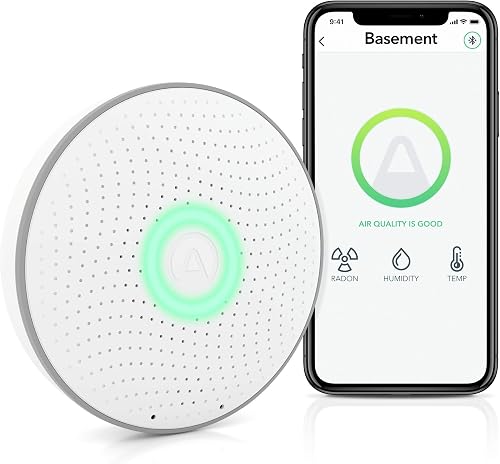
Best app-first option — Airthings sensing at the friendlier price
The Wave Radon is the Corentium’s smart-home sibling: no screen at all, just a ceiling-smoke-alarm-shaped puck that logs radon, temperature and humidity to the app over Bluetooth. The party trick — wave a hand in front of it and a ring glows green, amber or red against your radon average — sounds like a gimmick and is actually rather good design, because it gives the rest of the household an answer without anyone opening an app. Battery-powered on AAs, so placement is free. The catch is the same as all Bluetooth-only kit: data syncs when a phone wanders past, and the long-term history is only as complete as your habit of doing so.
For
- Frequently the cheapest route into Airthings radon sensing
- Battery-powered; glow ring needs no app to be useful
- Logs humidity and temperature alongside
Against
- No numeric display on the unit itself
- Bluetooth sync only — no remote monitoring
Typically £85–£120
Check price on AmazonRadonova Radtrak³ passive test kit

The definitive test — when the number needs to stand up on paper
This is the other philosophy entirely. The Radtrak³ is an alpha-track detector: a small plastic puck with no electronics, containing a film that radon decay products physically scar. Leave it in place for three months to a year, post it back, and an accredited laboratory counts the tracks and issues a report. It is the technology national radon programmes are built on, Radonova is one of the big international measurement labs, and the result is a long-term average by construction. For conveyancing, landlord records or an employer’s risk assessment, a lab certificate carries weight that a screenshot of an app never will. Worth knowing: UKHSA sells its own validated postal packs through ukradon.org, usually two detectors per home, and that route is often the cheapest of all.
For
- Accredited laboratory result — the version of the number officialdom accepts
- True long-term average; nothing to power, connect or fiddle with
- The same method the UK’s radon mapping is built on
Against
- One answer, months later — no live feedback at all
- Single-use; re-testing after mitigation means buying again
Typically £100–£140 with lab analysis included
Check price on AmazonForensics Detectors radon detector

Best on a budget — a proper screen and an alarm, no app required
Forensics Detectors is a California gas-detection outfit whose radon unit undercuts the big names while keeping the essentials: a colour screen with short and long-term values, an audible alarm, and a claimed twenty-year sensor life. No app, no cloud — for a certain kind of household, a feature. Two caveats from the published material: it’s a US-market device, so it may read in pCi/L out of the box (1 pCi/L is 37 Bq/m³ — convert before any number reassures you), and as with all budget continuous monitors, treat it as a screening tool. Let it average for weeks, and if it hovers near the action level, confirm with a lab-analysed pack before spending money on building work.
For
- Cheapest credible continuous monitor here
- Everything on the screen; no app, account or cloud
- Audible alarm suits a boiler-room or cellar posting
Against
- US units out of the box on some stock — check the settings
- Mains-powered; less published UK owner feedback than the big names
Typically £70–£90
Check price on AmazonWhat actually matters — and what doesn’t
Protocol beats hardware. Whichever device you buy, the measurement that means anything is a long one, in the right place: main living room and a bedroom, breathing height, away from windows and radiators, left alone for three months — ideally including winter, when levels peak. UKHSA applies a seasonal correction to three-month results for exactly that reason. A £170 monitor read after a breezy summer afternoon tells you less than a £60 passive pack done properly.
Digital and passive are complements, not rivals. The sensible pattern for a house in an Affected Area is a lab-analysed passive test for the definitive, on-paper answer, and a digital monitor afterwards to live with — watching winter, confirming mitigation keeps working, catching drift after building work changes the airtightness. If you can only buy one: passive for a transaction or a formal record, digital for curiosity and ongoing peace of mind.
High numbers are fixable, and fixing them is ventilation work. A radon sump — a small void formed under the floor slab with a pipe and a quiet fan — actively depressurises the ground beneath the house and routinely cuts high levels by 90 per cent or more. For moderate levels, positive input ventilation (a loft-mounted unit gently pressurising the house with filtered air) often brings the average under the target, and helps condensation into the bargain. Sealing floor penetrations and improving sub-floor ventilation to suspended timber floors support either. What doesn’t work: air purifiers. Radon is a gas; a HEPA filter does not touch it.
What the sales pages push that you can skip. Decimal places, mostly. Consumer radon sensors are counting sparse random decay events, which is why every honest spec sheet quotes accuracy that improves with averaging time — a live number to one decimal place is statistical theatre. The same goes for smart-home integrations that announce your radon level to the kitchen speaker, and for multi-gas dashboards on units whose radon sensing is the afterthought. Spend the money on the sensor and the averaging; if you want the full air-quality picture there are better tools for that job.
Questions I get asked
What is a safe radon level in the UK? There is no wholly safe level — risk scales with exposure — but UK policy draws two lines as annual averages: 200 Bq/m³ is the action level, above which you should take steps to reduce it, and 100 Bq/m³ is the target level to aim for when you do. For context, the UK indoor average is around 20 Bq/m³. A long-term reading in the tens is unremarkable; sustained triple digits deserves attention, not alarm — remediation is routine building work, not an exorcism.
How do I check the radon map for my house? The UKHSA’s interactive map at ukradon.org shows the probability band for any postcode, and a definitive address-level report costs a few pounds. It’s the same dataset a conveyancing environmental search draws on when it flags an Affected Area. Remember what the map is: the chance that a home in that spot exceeds the action level, based on geology and measurements nearby. It cannot tell you about your house — construction, floors and ventilation swing the actual figure enormously — so a flag on a search is a prompt to test, not a defect in itself.
How long does a radon test take? The standard UKHSA measurement is three months with two passive detectors, one in the living room and one in a bedroom, with a seasonal correction applied to estimate the annual average. Digital monitors will show you numbers within hours or days, and those are genuinely useful for spotting patterns — but treat anything under a month as provisional. Radon can vary several-fold between a windy week and a still one, and by a factor of two or more between summer and winter in the same house.
Do I need a radon test when buying a house? If the search flags an Affected Area, the pragmatic route is to ask whether the property has been tested before and whether any sump or fan system exists — then test yourself after completion, because three months rarely fits a conveyancing timetable. Price negotiation on the flag alone is usually disproportionate; a full radon sump installation is modest money against most defects a survey turns up. If the house already has mitigation, check the fan is actually running — they get switched off “because of the noise” more often than anyone admits.
If a search result, a survey or a worrying number is what brought you here, that’s the day job. The practice carries out building surveys across Sussex, Kent and the South East, and designs ventilation strategies — the discipline most radon mitigation actually belongs to — so get in touch if you’d like a professional eye on it. And if you’re building out the toolkit, there are more field-kit guides.
Small print. This guide is general information, not advice on your property; radon behaviour depends on the building and the ground beneath it, and decisions about mitigation should follow a proper long-term measurement. Prices are indicative, move constantly and were checked at the time of writing; the linked page always shows the current price. As an Amazon Associate I earn from qualifying purchases.