Pipe insulation does two separate jobs, and it's worth knowing which one you're solving for before you buy anything. Around cold-water pipework in an unheated loft or garage, it slows heat loss from the pipe, buying time before standing water freezes and expands enough to split it — it doesn't stop that happening in a hard enough or long enough freeze, whatever the packaging implies. Around hot water and heating pipework, the same lagging keeps paid-for heat inside the pipe instead of warming an unheated loft nobody uses, which shows up, in a small way, on an EPC. And on a cold pipe running through a warm, humid space — an airing cupboard, a bathroom stud wall — it stops the pipe sweating and dripping condensation onto whatever's stored nearby, a different job again wearing the same product.
It's cheap by the standards of anything else in a survey report, and one of the few defects a homeowner can genuinely fix in an afternoon rather than booking a tradesperson. The catch: most generic foam lagging is thinner than Building Regulations actually specify for compliant pipework — it matters less on a short exposed run, more on a long primary heating run through a cold loft. Below is how I'd judge what's on the shelf, and six products — foam, elastomeric rubber and genuine mineral wool — worth considering.
Worth saying up front: if pipes keep freezing despite proper lagging, or a garage conversion needs pipework kept genuinely warm through winter, insulation alone isn't the fix — that's a job for trace heating tape or, better, rerouting the pipe out of the cold space altogether. And if the real issue behind the call is heat loss across the whole house rather than one exposed pipe run, lagging a metre of copper won't move the needle much on its own.
The one I’d buy

K-Flex 9mm Wall 15mm Bore Self-Seal Pipe Insulation, 2m
Closed-cell nitrile rubber rather than plain foam, with a genuinely useful spec sheet on the listing itself rather than figures you have to chase down elsewhere: a −165°C to +110°C working range (to EN 14706), published thermal conductivity across four temperature bands, and a Euroclass B(L)-s2,d0 fire rating to EN 13501-1. It's the same elastomeric family as Armaflex at a noticeably lower price, which makes it the one I'd default to for most loft and garage runs where you want proper rubber rather than basic foam but don't specifically need the Armaflex name on the box.
Typically £8–£10 for a 2m length (15mm bore, 9mm wall)
Check price on AmazonHow I judge pipe insulation
Wall thickness against the diameter you're actually lagging. A 9mm wall on a small-bore pipe does more, proportionally, than the same 9mm on a wide one — Building Regs' own compliance table scales the required thickness by pipe diameter, not a flat figure across every size, so check the wall thickness against the bore you're buying for rather than assuming any foam tube does the same job.
Material and fire rating. Plain polyethylene foam is cheapest and most common, but combustible with no meaningful fire rating. Elastomeric nitrile rubber (Armaflex, K-Flex and similar) carries a genuine fire classification and wider temperature range, the spec called for on plant rooms and anywhere fire rating matters. Mineral wool sits above both — non-combustible, the usual choice near a boiler or hot flue.
Self-seal versus needing separate tape. Most of what's sold now has a factory-applied adhesive strip along the slit, so it closes around the pipe without extra fixings. It's worth checking before you buy a bulk roll — taping every joint by hand on a long loft run is a lot slower and rarely as neat.
Temperature range. A cold-water-only product is fine on the tank feed but isn't necessarily rated for the primary flow and return running alongside it. Check the stated range against what's actually in the pipe, not just what's in the loft.
Price against how much pipe you're actually covering. There's no need to spec a premium elastomeric rubber for a short cold-feed run to an outside tap when a length of basic foam does the same practical job for a fraction of the cost — save the better product for primary heating pipework and anywhere a fire rating genuinely matters.
The comparison
| Product | Material | Fire rating | Typical price | Best for | |
|---|---|---|---|---|---|
| K-Flex 9mm/15mm Self-Seal | Elastomeric rubber | Euroclass B(L)-s2,d0 | ~£8–£10 | Best all-round pick | View |
| Armaflex AF-1328 13mm/28mm | Elastomeric rubber | Class O (BS 476 Pt.6&7) | ~£12–£14 | Brand-name professional spec | View |
| Climaflex 15mm/9mm, 5m pack | PE foam | Euroclass E (combustible) | ~£6–£8 | Everyday DIY loft/garage runs | View |
| K-Rock 15mm/20mm foil-faced | Mineral wool | Non-combustible | ~£20–£24 | Near a boiler or hot flue | View |
| 22mm/13mm foam roll, 10m | PE foam | Not rated | ~£10–£12 | Budget pick, whole loft runs | View |
| DEMEDO self-adhesive tape | Foam wrap tape | Not rated | ~£10–£14 | Bends, valves, awkward fittings | View |
The picks in detail
K-Flex 9mm Wall 15mm Bore Self-Seal Pipe Insulation, 2m
Best all-round — genuine rubber spec at close to foam pricing
K-Flex is Armaflex's main competitor in the same closed-cell nitrile rubber category, and this listing carries its own published datasheet rather than leaving you to hunt for one — a −165°C to +110°C range to EN 14706, conductivity across four bands, and a Euroclass B(L)-s2,d0 fire rating to EN 13501-1. The self-seal strip closes the slit without extra tape, and at roughly two-thirds Armaflex's price for the equivalent size it's the one I'd reach for first on an ordinary loft or garage run.
For
- Genuine elastomeric rubber with a published datasheet on the listing itself
- Wide temperature range covers both cold feed and primary heating pipework
- Self-seal closure, no separate tape needed
Against
- Euroclass B is a different test regime from Armaflex's older Class O (BS 476) rating — don't treat the two as interchangeable if a spec explicitly calls for one
Typically £8–£10 for a 2m length
Check price on AmazonArmaflex AF-1328 Selfseal Class O Pipe Insulation, 13mm Wall, 28mm, 2m
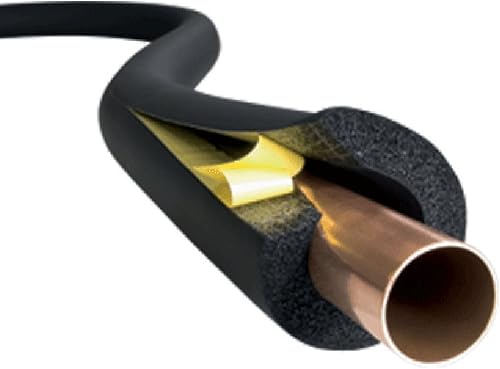
Best where a specification names Armaflex or Class O by name
Armaflex is the name most surveyors and installers actually say out loud on site, and this is its self-seal domestic line — closed-cell nitrile rubber carrying the historic UK “Class O” classification to BS 476 Parts 6 and 7, still referenced on plenty of specifications and landlord compliance documents. It's a heavier wall (13mm) than the K-Flex pick above at the same 28mm bore, worth factoring in if you're comparing price per length rather than price per pack.
For
- The recognised brand name where a spec or landlord document names Armaflex or Class O specifically
- Self-seal closure, no separate tape needed
- Genuine Class O fire classification to BS 476 Parts 6 & 7
Against
- Priced noticeably above the equivalent K-Flex or Climaflex size for the same basic job
- Class O (BS 476) isn't the same test as the newer EN 13501-1 Euroclass system — check which one a specification actually asks for
Typically £12–£14 for a 2m length
Check price on AmazonClimaflex Pipe Insulation, 15mm x 9mm, 5m Pack

The everyday product most people actually mean by “pipe lagging”
Pre-slit closed-cell polyethylene foam, sold in the widest range of bore and wall combinations here — 15mm up to 42mm bore, 9mm to 25mm wall — making it the easy default for lagging a loft's worth of mixed pipe sizes in one order. It's combustible with no fire rating to speak of, ruling it out where a spec calls for a rated product, but for an ordinary domestic cold feed or garage run it's what most trade and DIY sellers actually mean by pipe lagging.
For
- Widest range of bore and wall sizes of any product here
- Cheapest way to cover a lot of mixed pipe diameters in one loft
- Pre-slit, self-seal closure
Against
- Combustible foam, no meaningful fire rating — not the pick where one's specified
- Thinner walls than the elastomeric picks at the equivalent price point
Typically £6–£8 for a 5m pack (15mm bore, 9mm wall)
Check price on AmazonK-Rock 15x20mm Foil Backed Pipe Insulation, Pack of 3 x 1m

Non-combustible pick, for pipework near a boiler or flue
Genuine moulded rock/mineral wool in a foil-faced, snap-on split section rather than a foam or rubber tube — noticeably pricier per metre, the trade-off for a non-combustible material rather than one that's merely fire-rated. Worth flagging plainly: this is sold under the K-Rock name by an Amazon-marketplace brand, not the ROCKWOOL Group's own product line, which I couldn't find sold direct to consumers on Amazon UK at all — genuine mineral wool, just not that manufacturer's badge on the box.
For
- Non-combustible mineral wool, the material to use near a boiler or hot flue
- Foil facing gives a useful vapour check as well as insulation
Against
- The most expensive product here per metre by some margin
- Not a ROCKWOOL Group-branded product, despite the similar name — genuine mineral wool from a different manufacturer
Typically £20–£24 for a pack of three 1m lengths
Check price on Amazon22mm x 13mm Foam Pipe Insulation Lagging Wrap Roll, 10m

Budget pick — cheapest per metre for a long, mixed run
A continuous 10m roll rather than pre-cut lengths, cheaper per metre than most packaged foam or rubber and suited to lagging a long, straightforward run in one go rather than joining short sections. It's an unbranded marketplace product with no published conductivity or fire rating, so treat any performance figure elsewhere as an assumption — fine for a cold-water run where the job is buying time before a freeze, not the pick for primary heating pipework or anywhere a spec matters.
For
- Cheapest per metre of any product in this guide
- One continuous length — fewer joins on a long run
Against
- No published thermal conductivity or fire rating
- Unbranded — treat spec claims elsewhere online with caution
Typically £10–£12 for a 10m roll
Check price on AmazonDEMEDO Pipe Insulation Tape, 2 Inch x 16.5ft
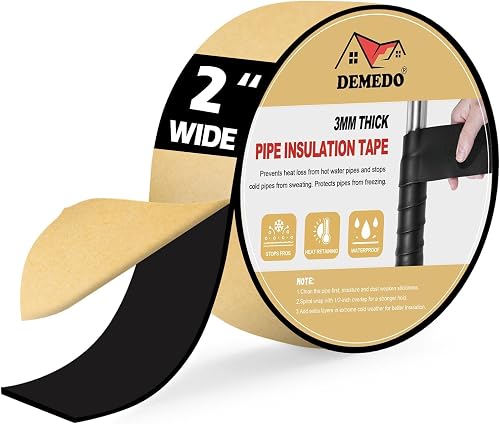
For the bends, valves and stopcocks a tube can't cover
Every product above is a straight tube, fine along a run but useless around a bend, T-piece or stopcock — the coldest, most exposed points on most systems. This self-adhesive foam wrap spirals on by hand with an overlap, closing round whatever shape it meets rather than needing a mitred cut. It's one of several near-identical listings in this sub-category, so buy it as a functional wrap for awkward fittings, not for any specific performance figure.
For
- The only product here that wraps around bends, valves and stopcocks properly
- No cutting or mitring needed — spiral-wraps to shape
Against
- No published thermal performance data
- A crowded category of near-identical unbranded listings — check the current price carefully before buying
Typically £10–£14 per roll
Check price on AmazonWhat actually matters — and what doesn’t
Most off-the-shelf foam and rubber is thinner than Building Regs actually specify. Approved Document L (Volume 1: Dwellings) requires hot water storage pipework to be insulated for at least 1m from the cylinder connections, and sets minimum thicknesses in its Table 4.4 by pipe diameter — but those figures assume a thermal conductivity of 0.025 W/(m·K) or better. None of the mainstream products here reach that: Climaflex sits around 0.034–0.038 W/(m·K), K-Flex and Armaflex around 0.035. A 9–13mm wall on ordinary foam or rubber doesn't automatically satisfy the simplified table at every diameter — either the wall thickness needs increasing pro-rata, or compliance is demonstrated through the fuller BS 5422:2023 calculation instead. Worth knowing before assuming any lagging is “Part L compliant” simply because it's insulation.
BS 5422 was updated in 2023 — check which version a source is quoting. This is the standard that governs how thickness is calculated by pipe diameter and temperature. The 2009 edition (amended 2014) was withdrawn on 30 June 2023 and replaced by BS 5422:2023 — plenty of trade content online still cites the old edition as current.
Fire ratings aren't all measured the same way. Armaflex's “Class O” is the older UK surface spread of flame classification to BS 476 Parts 6 and 7; K-Flex's Euroclass B(L)-s2,d0 is a separate, newer test to EN 13501-1. Both are genuine, but not interchangeable — if a specification names one system, match it rather than assuming any “fire-rated” product satisfies it.
Lagging slows heat loss, it doesn't stop freezing outright. In a prolonged hard freeze with no heating running, an insulated pipe still eventually reaches freezing — insulation buys hours, not immunity. Where pipes have frozen or split repeatedly despite being lagged, the fix is usually trace heating tape under the insulation, or moving the run out of the cold space, not a thicker wrap.
It won't fix a genuinely cold house, and it's not a leak repair. A metre of lagging on one exposed pipe does nothing for a whole-house heat loss problem, and nothing for a joint that's actually failed — that's a plumber's job, not an insulation one.
Questions I get asked
Do I need to insulate every pipe in the loft, or just the exposed ones? Focus on anything running through an unheated space — loft, garage, exterior wall void — especially the last metre or so nearest the cold water tank or cylinder connections, which Approved Document L specifically calls out. Pipework already buried inside a warm, insulated floor or wall doesn't need it.
Does pipe insulation actually show up on an EPC? Yes, in a small way — the RdSAP assessment behind a domestic EPC records whether primary hot water pipework is insulated as one input to the heating system's assumed efficiency. It won't move a rating by itself, but it's one more box genuinely ticked rather than flagged.
Can I use pipe insulation instead of proper loft insulation? No — different problems. Pipe lagging cuts heat loss from that specific pipework; it does nothing for the fabric heat loss through the roof that loft insulation addresses. Both jobs are usually worth doing, but one doesn't substitute for the other.
What thickness do I actually need? For an ordinary cold feed, 9–13mm foam or rubber matched to the pipe bore is the normal DIY spec. For primary heating pipework, or where a specification names a standard directly, check the wall thickness against BS 5422:2023's tables for the actual diameter and water temperature rather than assuming any off-the-shelf product covers it.
Pipe insulation isn't its own line item on a domestic EPC visit, but primary pipework insulation is one of the smaller inputs behind the rating, and it's exactly the cheap, easy fix I'll flag on the day rather than leave for someone to discover the hard way. Weighing this up alongside a wider heating upgrade, my guides to new boiler costs and what an EPC costs are worth reading too. Get in touch for a second opinion, and there are more field-kit guides to work through.
Small print. This guide is general information, not a specification for a particular property — check the relevant standard directly where fire rating or Building Regs compliance genuinely matters. Prices are indicative, move constantly and are checked at the time of writing; the linked page always shows the current price. As an Amazon Associate I earn from qualifying purchases.