Most surveys involve running something off mains power at some point — a work light down a suspended timber floor void, a laptop on charge while filling in RdSAP data on-site, a dehumidifier or moisture trap left reading overnight in a property that's failed a damp diagnosis. On a lot of the stock that gets surveyed, particularly anything not rewired since the 1970s or ’80s, that supply comes from a consumer unit with no RCD protection on the socket circuits at all — rarely obvious from a doorstep, and not always worth the time to check before plugging something in.
An RCD extension lead solves that without needing to trust the building's own wiring. It monitors the current going out against the current coming back, and if the two stop matching — because a live conductor's found an earth path through someone holding the cable, say — it cuts the supply in tens of milliseconds, fast enough to prevent a fatal shock. That's a genuinely different thing to the surge protection or thermal cut-out fitted to most household multi-socket leads, which guard electronics or a cable but do nothing for an earth fault.
What follows is what actually matters when buying one for survey work, and seven products worth having in the van — from a proper site-grade case reel through to a pocket adaptor that turns any existing lead RCD-safe.
The one I’d buy
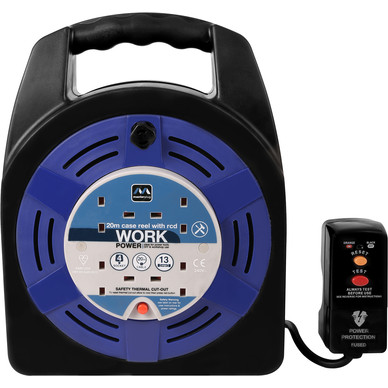
Masterplug Case Reel & RCD 4G 240V 20m
The case is the detail that earns this the top spot for a working van: rather than a bare reel that rolls around loose, 20 metres of cable, the plug and the RCD itself all live inside one grabbable case. Four sockets cover a work light, a laptop charger and a dehumidifier off one lead without daisy-chaining, and the RCD sits at the plug end, protecting the full run rather than just whatever's plugged into the last socket. Rated 13A, which comfortably covers instrument and light-tool loads without paying for current headroom that never gets used.
Typically £35–£45
Check price on AmazonHow I judge an RCD extension lead
Whether the RCD protects the whole cable run, or just the last few inches. A plug-in adaptor at the wall end, upstream of everything else, protects the entire run to whatever's plugged in at the far end; an RCD built into the tool end only catches a fault in the tool itself, not a lead that's been nicked crossing a loft hatch or trodden into a puddle in a cellar.
A genuine 30mA trip current, not just “safety features” printed on the box. 30mA within 40ms — some units manage under 20ms — is the figure that actually matters for protection against electric shock. Worth checking the spec sheet rather than trusting packaging that just says “safe” or “protected”.
Current rating matched to what's actually being run. A damp meter, a work light or a laptop charger draws next to nothing; 13A covers all of it comfortably. 16A only starts to matter once an SDS drill or a site radio joins the same lead, and paying for headroom that's never used is money better spent on cable length.
An IP rating, or at least a decent seal, if it's going anywhere near water. Half of what an RCD protects against is exactly the environment survey work happens in — standing water in a cellar, condensation in a crawl space, drizzle across a driveway. A plug adaptor with no weather rating at all belongs indoors only.
Whether it resets itself or needs a manual reset after a trip. A non-latching unit won't silently re-energise something left running unattended — a dehumidifier or a moisture trap left overnight — after a nuisance trip or a power cut, which matters more than it sounds for kit left running on an empty property.
The comparison
| Model | Type | Amp rating | RCD trip | Typical price | Best for | |
|---|---|---|---|---|---|---|
| Masterplug Case Reel & RCD 4G 20m | Case cable reel | 13A | 30mA | ~£40 | Best overall | View |
| Draper 26341 Garden Cable Reel, 25m | Cable reel + adaptor | 10A | 30mA | ~£55 | Best value reel | View |
| Draper RCD3 13A RCD Adaptor | Plug-in adaptor | 13A | 30mA | ~£20 | Best budget pick | View |
| Masterplug ARCDKG Safety Adaptor | Plug-in adaptor | 13A | 30mA | ~£13 | Best non-latching adaptor | View |
| Draper 98440 In-line RCD Adaptor | In-line adaptor | 16A | 30mA | ~£42 | Best for higher-current tools | View |
| Defender E11085C In-line RCD Unit | In-line fly lead | 13A→16A | 30mA | ~£25 | Best professional pick | View |
| SAFEMORE RCD Extension Lead, 4 Gang | Multi-socket RCD lead | 13A | 30mA | ~£28 | Best for indoor distribution | View |
The picks in detail
Masterplug Case Reel & RCD 4G 240V 20m
Best overall — the one I’d buy, above
The case format is what separates this from a bare reel rolling around loose in the back of a van — 20 metres of cable, the plug and the RCD all live in one contained, grabbable unit. Four sockets are enough to run a light, a charger and an instrument off one lead without daisy-chaining, and because the RCD sits at the plug end it protects the entire run rather than just the last socket. 13A is plenty for instrument and light-tool loads without paying for current headroom nobody uses.
For
- Case keeps cable, plug and RCD together rather than loose in a bag
- Four sockets cover a light, a charger and an instrument off one lead
- RCD sits at the plug end, protecting the whole cable run
Against
- 20m is enough for most survey work but not a long site run
- The case adds bulk over a bare reel of the same length
Typically £35–£45
Check price on AmazonDraper 26341 Four Socket Garden Cable Reel with RCD Adaptor, 25m
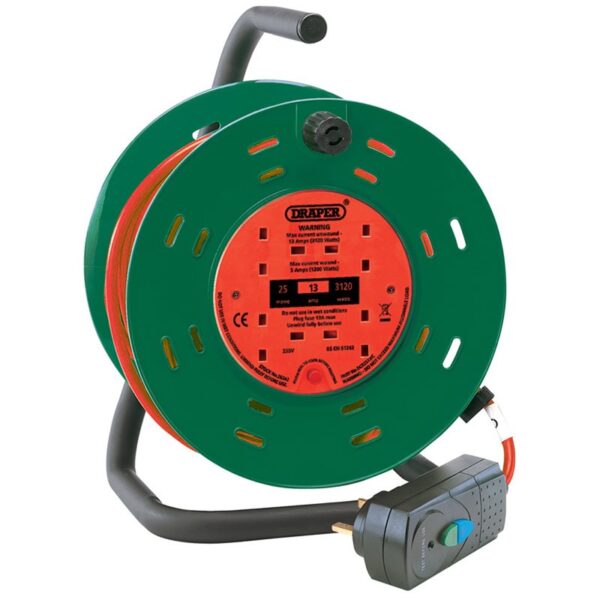
Best value reel — five metres further for less outlay
Marketed at the garden end of Draper's range rather than the trade end, and priced accordingly, but the spec holds up fine for survey work — five metres more cable than the Masterplug above, four gated sockets, and an RCD adaptor rated to the same 30mA trip current. The lower 10A rating is the trade-off for the price, which is still comfortably enough for a damp meter, a laser or a work light, but rules out anything that pulls harder, like an SDS drill.
For
- Longer cable than the case-reel pick, for less money
- Gated sockets are a genuine foreign-object safeguard, not just marketing
- Same 30mA RCD protection as the pricier picks
Against
- 10A rating rules out heavier power tools
- No case — the reel sits loose in the back of a van
Typically £45–£60
Check price on AmazonDraper RCD3 230V 13A RCD Adaptor
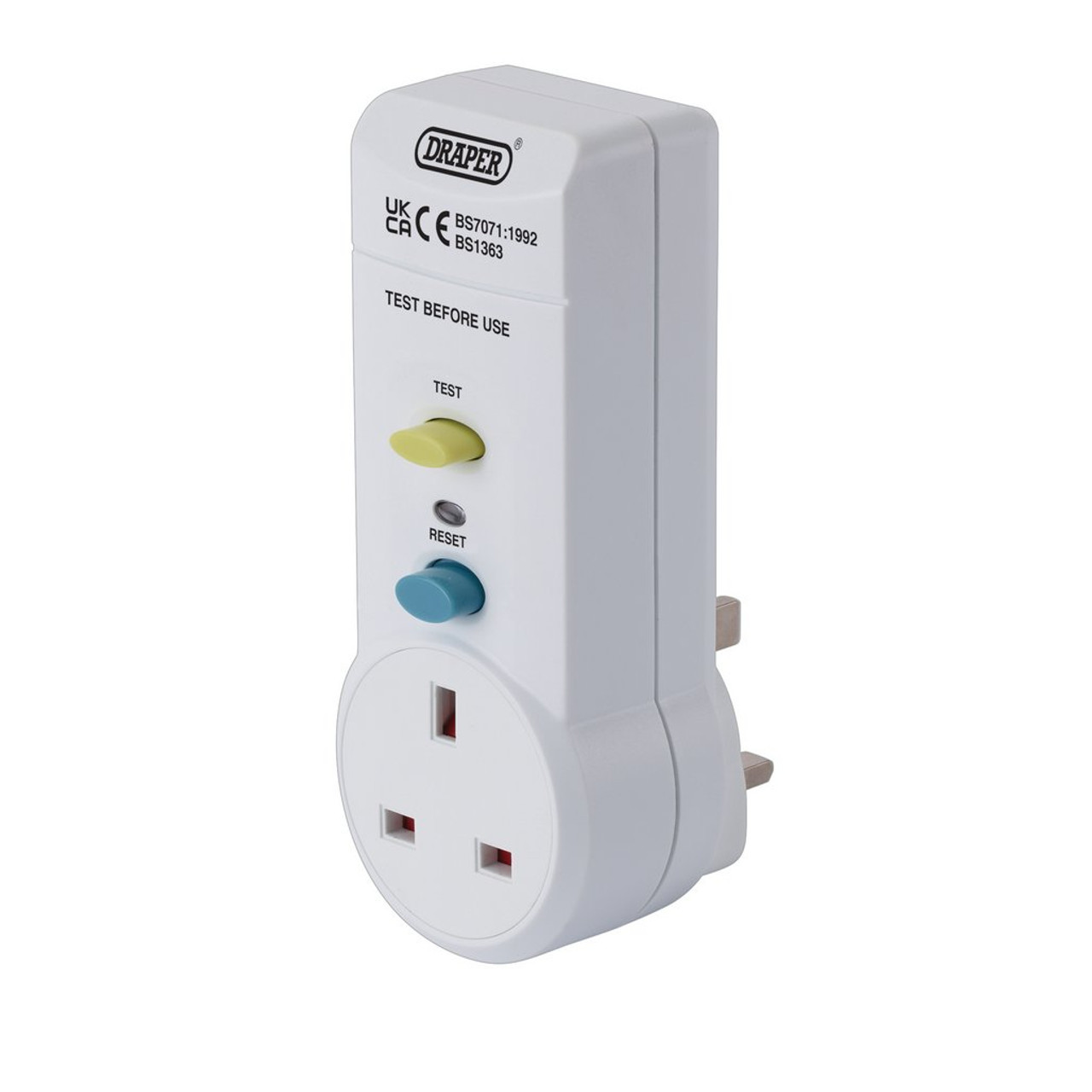
Best budget pick — turns any existing lead RCD-safe
The cheapest genuine route to RCD protection on this list: rather than replacing a perfectly good extension lead, this plugs into the wall first, and the existing lead plugs into it — adding a proper 30mA, 40ms trip to whatever's already in the van. A sensible first buy for anyone whose current leads have no RCD protection at all, and small enough to live in a door pocket rather than a toolbox.
For
- Cheapest way to add real RCD protection to an existing lead
- Small enough to keep in a door pocket or glovebox
- Reset and test buttons built in
Against
- Only protects whatever's plugged in downstream of it
- No weatherproofing — indoor/dry use only
Typically £15–£25
Check price on AmazonMasterplug ARCDKG Single Socket RCD Safety Adaptor
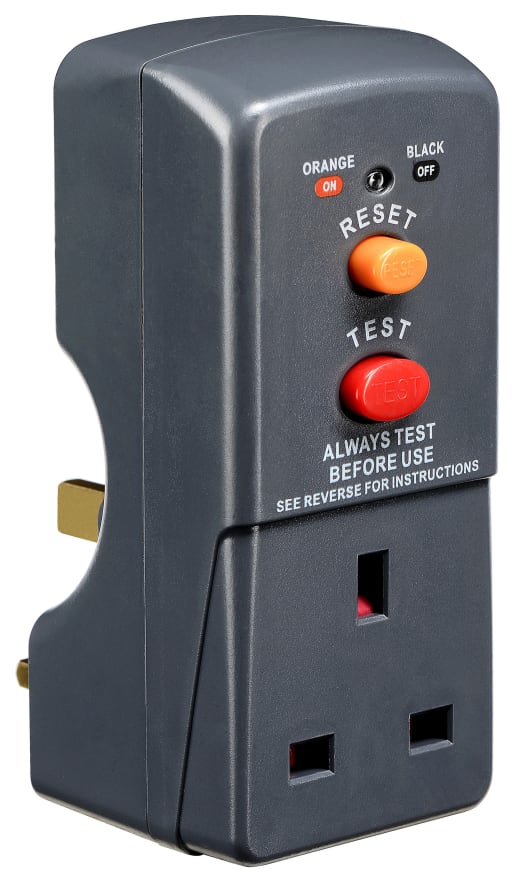
Best non-latching adaptor — won’t quietly restart something left running
Functionally similar to the Draper above, with one difference worth knowing: it's non-latching, so after a trip or a power cut it stays off until someone manually resets it, rather than silently re-energising. That matters for anything left running unattended on an empty property — a dehumidifier or a moisture trap running overnight in a room nobody's checking.
For
- Non-latching behaviour won’t silently restart kit after a power cut
- Compact, barely wider than a standard plug
- Well-proven, widely reviewed design
Against
- Single socket only, so still needs a lead plugged into it
- Indoor/dry use only, same as the Draper adaptor
Typically £10–£18
Check price on AmazonDraper 230V In-line RCD Adaptor, 16A
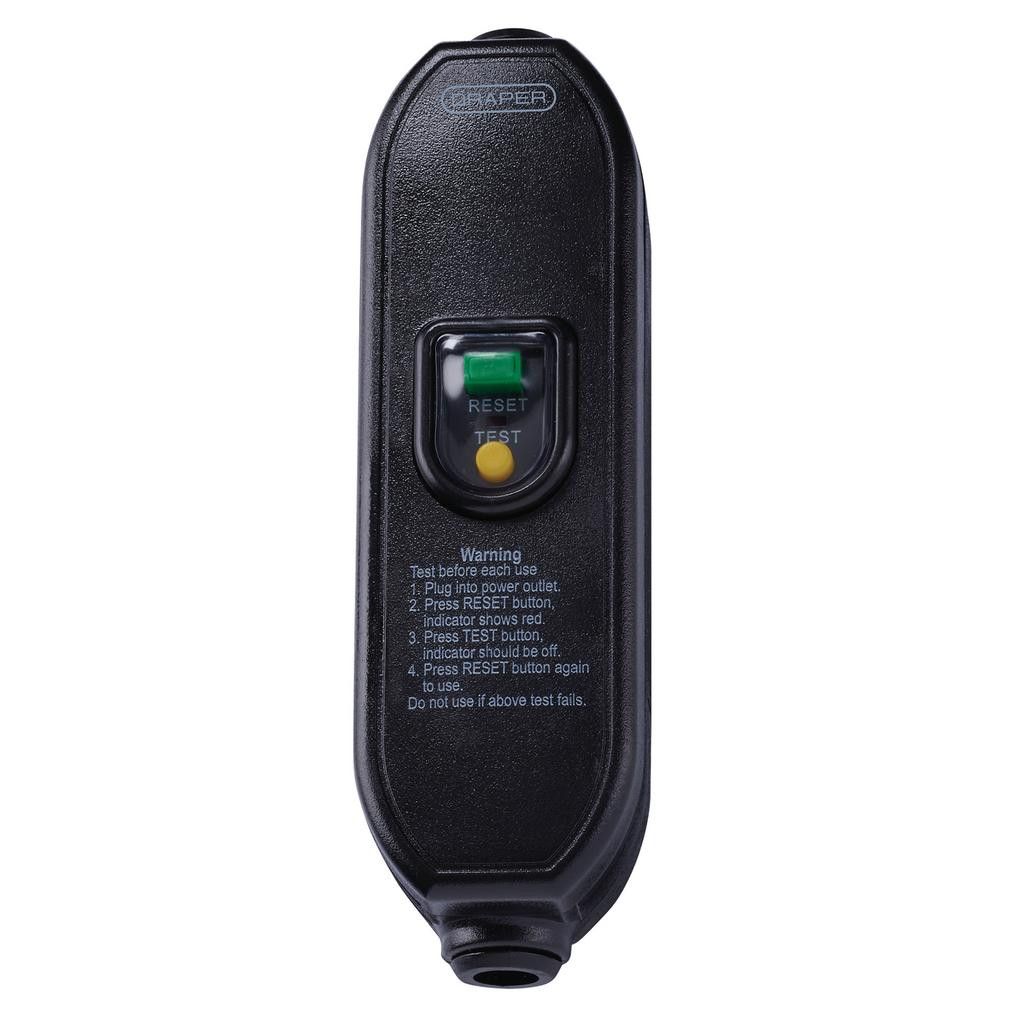
Best for higher-current tools — steps a lead up to 16A with RCD protection
A different job to the plug-in adaptors above: this sits mid-cable, stepping the connection up to a 16A, IP66-rated coupling — the rating that starts to matter once an SDS drill or a mixer joins the kit list rather than instruments alone. The 15ms trip speed beats the 40ms of the budget adaptors, and the IP66 seal survives being left out in drizzle rather than needing to come indoors between uses.
For
- 16A rating and IP66 seal suit heavier power tools and wet conditions
- Faster 15ms trip speed than the budget plug adaptors
- Sits mid-cable, protecting a longer run than a lead-end adaptor
Against
- Costs roughly double the basic plug adaptors
- Overkill for instrument-only survey work
Typically £35–£50
Check price on AmazonDefender E11085C In-line RCD Unit, 13A Plug/16A Socket, 240V

Best professional pick — converts a 13A supply to a genuine 16A tool connection
The genuinely trade-grade option here: a 13A plug at one end, a 16A industrial-style socket at the other, and an in-line RCD in between, so a 16A tool can run off an ordinary wall socket without rewiring anything. It's the one to reach for when a job needs a proper power tool rather than instrument kit — opening up a section of wall, say — and the industrial socket holds up better to being dropped in mud than a domestic plug does.
For
- Converts a standard 13A supply to a proper 16A tool connection
- Industrial socket format holds up better to site abuse than a domestic plug
- RCD sits in the same short lead, so it travels as one unit
Against
- Only 1m of cable, so it needs pairing with a separate extension lead
- Pricier than a simple plug adaptor for what is, functionally, a converter
Typically £20–£30
Check price on AmazonSAFEMORE RCD Extension Lead with RCBO, 4 Gang, 3m
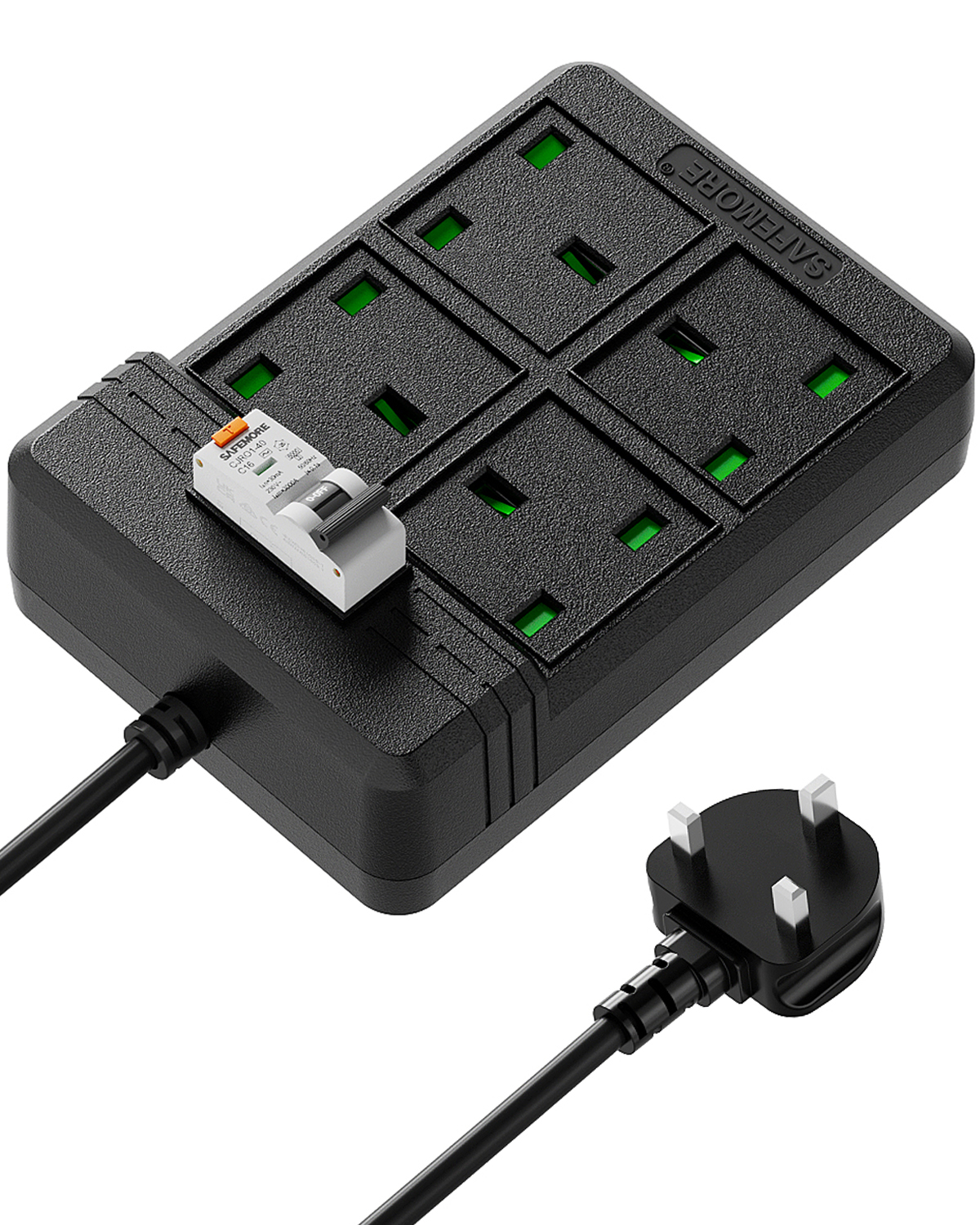
Best for indoor distribution — four RCD-protected sockets off one supply
Useful for a different scenario to the reels above: rather than running power out to a work area, this splits one RCD-protected supply into four sockets close to where the work's actually happening — a loft hatch, a crawl space access point, a row of instruments charging off one extension in a van doorway. The RCBO trips fast on an earth fault and resets manually rather than restoring power on its own.
For
- Four RCD-protected sockets from one supply, useful for multiple instruments at once
- RCBO protection resets manually rather than restarting unattended
- Bright cable is easy to spot as a trip hazard on site
Against
- 3m won’t reach far without an extension lead ahead of it
- Newer brand with a shorter track record than Draper or Masterplug
Typically £25–£35
Check price on AmazonWhat actually matters — and what doesn’t
An RCD extension lead is personal protection, not a substitute for the property's fixed installation. It protects whoever's using it from a fault in that cable run; it says nothing about the rest of a building's wiring, which is exactly why survey work turns up so many consumer units with no RCD protection at all on the sockets circuit.
Where the RCD sits in the chain changes what it actually protects. Plug it in first, upstream of everything else, and it covers the entire run to wherever the tool ends up; plug it in at the tool end only, and a damaged cable between the wall and the RCD is unprotected the whole time.
Higher current ratings are wasted money on instrument-only kit. 16A and 32A ratings exist for tools drawing real power — a mixer, an SDS drill running continuously. A damp meter, a laser or a laptop charger never gets close to 13A, let alone 16A.
Surge protection and RCD protection are not the same thing. A surge-protected multi-socket lead guards against voltage spikes damaging electronics; it does nothing for an earth fault putting a current through someone holding the cable. Check for an actual RCD trip current spec, not just “protected” on the box.
The test button is there to be used, not ignored. An RCD that hasn't been tested in months is an RCD nobody actually knows works — pressing test before a job involving water or damp takes ten seconds and confirms the trip mechanism hasn't seized.
Questions I get asked
Do I need an RCD extension lead if the property's already got RCD protection on its consumer unit? Not every property does — a lot of older stock, particularly anything not rewired since the 1980s, has sockets on a circuit with no RCD protection at all, and there's rarely a reliable way to confirm that from a doorstep. An RCD extension lead removes the guesswork and travels with the surveyor rather than depending on what's already fitted.
What's the actual difference between a “safety” extension lead and one with RCD protection? Most multi-socket leads marketed on safety features are describing surge protection or a thermal cut-out, neither of which protects against an earth fault. Only a genuine RCD, usually quoted as a 30mA trip current, protects against the kind of fault that causes an electric shock.
Should the RCD go at the wall end or the tool end of a long cable run? At the wall end, ahead of everything else, protects the whole run — the cable itself as well as whatever's plugged into it at the far end. A fly lead like the Defender above only protects from that point onward, which is why the two aren't really interchangeable if the cable's crossing a loft hatch or a wet floor.
Is 13A enough, or is it worth paying for a 16A extension lead? For instrument kit, work lights and charging — the bulk of what gets run off mains on a survey — 13A is plenty, and a 16A lead pays for headroom that never gets used. 16A only earns its keep once an actual power tool with a real current draw joins the kit list.
Getting power to where it's needed safely is a small piece of a much bigger job — the same care that goes into checking an RCD's trip time extends to reading a voltage tester correctly before assuming a circuit's dead, or choosing a work light that survives being run off the same lead in a crawl space. The practice covers building surveys, EPCs and PAS 2035 retrofit assessments across the South East, all of it run out of a van that carries exactly this kind of kit — get in touch. And for more of what goes in the back, there are more field-kit guides.
Small print. This guide is general information, not electrical safety advice; an RCD extension lead is a useful additional safeguard but does not replace a periodic inspection of a property's fixed wiring, and any concerns about the condition of an installation should be raised with a qualified electrician. Prices are indicative, move constantly and were checked at the time of writing; the linked page always shows the current price. As an Amazon Associate I earn from qualifying purchases.