Noise doesn’t leave a stain on a ceiling, which is probably why it gets underweighted on a lot of survey instructions. But it comes up constantly in the parts of the job that never make it into the photographs: a tenant convinced a neighbour’s television comes through the party wall, a seller disputing that a new junction layout has ruined the garden, a retrofit client certain the MVHR unit fitted last month is louder than the fan it replaced. In every one of those conversations, a number beats an opinion.
A handheld decibel meter is not the instrument that settles a statutory nuisance case — that matters more than which model you buy, and I come back to it below. What one is good for is turning “it’s really noisy” into “68dB(A) at the window with the extractor running, 42dB(A) with it off”: a fact a client or neighbour can work with. Read the buying-advice section even if you skip straight to the table. What separates a useful meter from a toy isn’t a flashy display — it’s honest weighting, a sensible response speed, and a windscreen that means you’re measuring the room, not the draught.
The one I’d buy

Extech 407730 Sound Level Meter
A straightforward dB(A)/dB(C) meter from a proper test-and-measurement brand (Extech sits under the Teledyne/FLIR stable): a condenser microphone under a windscreen, fast/slow response, max-hold so a passing lorry doesn’t slip past unread, and 0.1dB resolution — fine enough to notice a fan cycling on. It won’t come with a calibration certificate, but for comparing a room with and without the noise source running, it’s exactly enough instrument.
Typically £110–£150
Check price on AmazonHow I judge a decibel meter
A-weighting as standard. Human hearing isn’t equally sensitive across all frequencies, so dB(A) rolls the low end off to approximate what a person perceives — the scale almost every noise-nuisance standard is written around. dB(C) is flatter and matters for low-frequency thump — plant, bass, traffic rumble — so a meter offering both tells you more than one that only does A.
A real fast/slow switch. Fast response tracks a spike — a door slam, a passing van; slow response averages it out, closer to how a sustained nuisance actually reads. A meter that only does one speed only answers half the question.
Max/min hold. A single instantaneous reading is nearly useless for anything intermittent. Capturing a peak while you’re not staring at the screen — a passing HGV, an extractor kicking into boost — turns a meter into a record rather than a glance.
A windscreen, not an afterthought. Wind noise across a bare microphone adds several decibels of pure artefact, which matters enormously outdoors. A meter sold without one, or treating one as an optional accessory, is telling you how seriously outdoor use was considered.
Honesty about compliance. A handful of these genuinely meet IEC 61672 or EN 60651 Class 2; most budget imports simply don’t claim it, which is more honest than a vague “professional” sticker with no standard named. Knowing which camp a meter sits in tells you what its number is worth.
The comparison
| Model | Type | Compliance | Typical price | Best for | |
|---|---|---|---|---|---|
| Extech 407730 | Digital, dB(A)/dB(C) | Not stated | ~£130 | An all-round meter with proper basics | View |
| Voltcraft SL-200 | Digital, dB(A)/dB(C) | EN 60651 Class 2 / EN 61672 | ~£80 | Formal compliance-grade readings | View |
| UNI-T UT353BT | Digital, Bluetooth logging | Not stated | ~£38 | Tracking a reading over time via app | View |
| Draper Handheld Digital | Digital, sound + temp/RH | Not stated | ~£33 | One meter for noise, temperature and humidity | View |
| BAFX Products | Digital, dB(A)/dB(C) | Not stated | ~£32 | The Amazon bestseller, with caveats | View |
| RISEPRO HT-80A | Digital, dual range | Not stated | ~£24 | Budget dual-range with a carry case | View |
| Silverline 633937 | Analogue, needle dial | Not stated | ~£18 | Best on a budget | View |
The picks in detail
Extech 407730 Sound Level Meter
Best overall — a properly specified meter without the compliance-grade price
The 407730 measures 40–130dB across both A and C weighting, with 0.1dB resolution and a manufacturer-quoted accuracy of ±2dB. The fast/slow switch and max-hold both work as they should, the analogue bargraph gives a sense of trend at a glance, and the windscreen is fitted as standard rather than sold separately. It runs on four AA batteries rather than hunting for a 9V PP3 in the van.
What it doesn’t give you is a stated compliance standard — the datasheet lists accuracy and resolution but doesn’t claim IEC 61672 or EN 60651 Class 2. For a comparative reading that’s irrelevant; for anything you might need to defend formally, that’s what the Voltcraft below is for.
For
- A and C weighting, fast/slow response, max-hold all present and correctly implemented
- 0.1dB resolution and a windscreen fitted as standard
- AA batteries rather than a single 9V
Against
- No stated compliance standard
- Pricier than the meters below for what is still an indicative instrument
Typically £110–£150
Check price on AmazonVoltcraft SL-200 Sound Level Meter
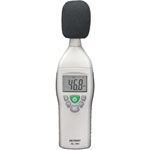
Best for formal compliance work — genuinely certified, not just badged “professional”
Voltcraft is Conrad Electronic’s own-brand test-equipment range, sold widely through UK trade suppliers, and the SL-200 is the meter here that actually names a standard it meets: EN 60651 Class 2 and EN 61672. That matters if a reading might ever need to be defended — to an environmental health officer, a freeholder, or a solicitor — because “Class 2 compliant” is a specific, checkable claim rather than marketing language. It covers 30–130dB across 31.5Hz–8kHz with A/C weighting and both response speeds, and ships with a case and windscreen as standard.
It’s still not a Class 1 laboratory instrument, and it won’t arrive with its own calibration certificate — for that you’re into acoustic-consultancy territory, covered below. But for the gap between informal opinion and a full acoustic survey, this is about as far as a sub-£100 instrument credibly reaches.
For
- Names a genuine compliance standard (EN 60651 Class 2 / EN 61672)
- Full 30–130dB range with A/C weighting and both response speeds
- Case and windscreen included as standard
Against
- No calibration certificate supplied — that’s a separate, pricier step
- 9V PP3 battery rather than AA
Typically £70–£95
Check price on AmazonUNI-T UT353BT Sound Level Meter

Best for tracking a complaint over time — Bluetooth logging to a phone
UNI-T is a large, established Chinese test-equipment manufacturer rather than an unbranded import, and the UT353BT is its mini sound meter with Bluetooth added: readings stream to UNI-T’s free iENV app for logging, graphing and export. For a complaint that plays out over days rather than one visit — is the plant equipment next door actually louder at 7am than 7pm — that trail beats a marginally tighter accuracy spec. Core numbers are 30–130dB with ±1.5dB accuracy and 0.1dB resolution, on a par with meters twice the price.
The app is functional rather than polished — owner feedback says Bluetooth pairing occasionally needs a restart — but as a record-keeping tool rather than a one-off spot check, it earns its place.
For
- Bluetooth logging to a free app — genuinely useful for tracking a complaint over days
- ±1.5dB accuracy and 0.1dB resolution at a mid-budget price
- Established brand rather than an anonymous import
Against
- App and Bluetooth pairing feel a generation behind the hardware
- No stated compliance standard
Typically £30–£45
Check price on AmazonDraper Handheld Digital Sound Level Meter
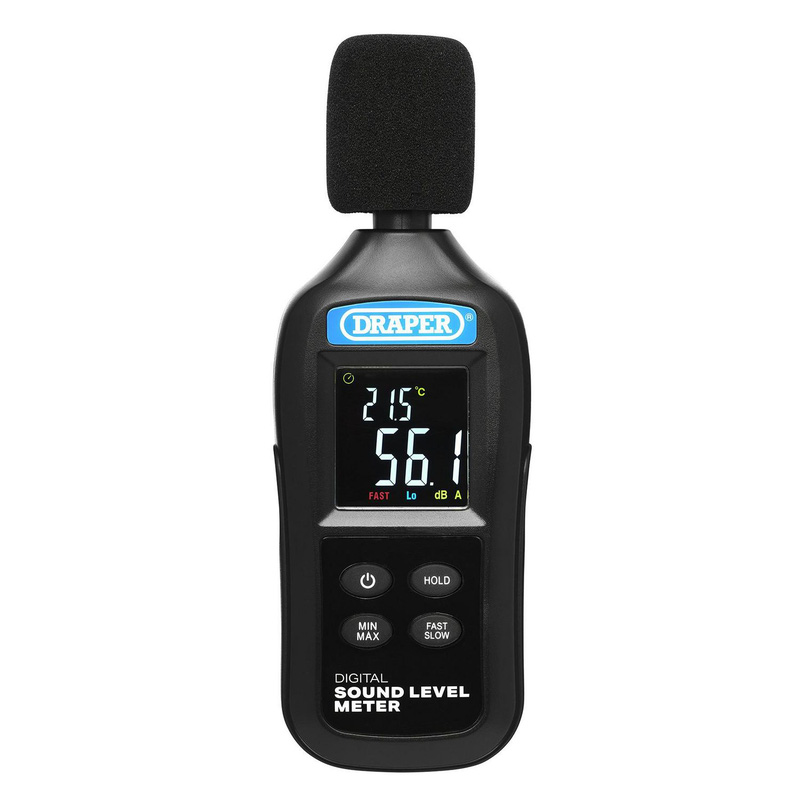
Best combined instrument — noise, temperature and humidity from one meter
Draper needs no introduction on a trade counter, and this is the meter for anyone who’d rather carry one instrument than three: alongside a dB reading it displays ambient temperature (-20°C to +70°C) and relative humidity (0–100% RH) on the same backlit screen. For a general condition visit where noise, damp risk and thermal comfort might all get a passing mention, that’s a genuinely useful combination — one pocket-sized unit instead of reaching for a separate hygrometer.
The trade-off is depth: it does all three jobs reasonably rather than any one exceptionally, and Draper doesn’t publish a dB range or compliance standard for the sound function. Treat the dB reading as indicative — useful for a quick comparison, not something to quote a figure from.
For
- Noise, temperature and humidity from one pocket-sized unit
- Backlit dual display, min/max and data hold
- A recognised, widely stocked trade brand
Against
- No published dB range or compliance standard for the sound function
- A generalist, not a dedicated sound meter
Typically £28–£38
Check price on AmazonBAFX Products Decibel Meter
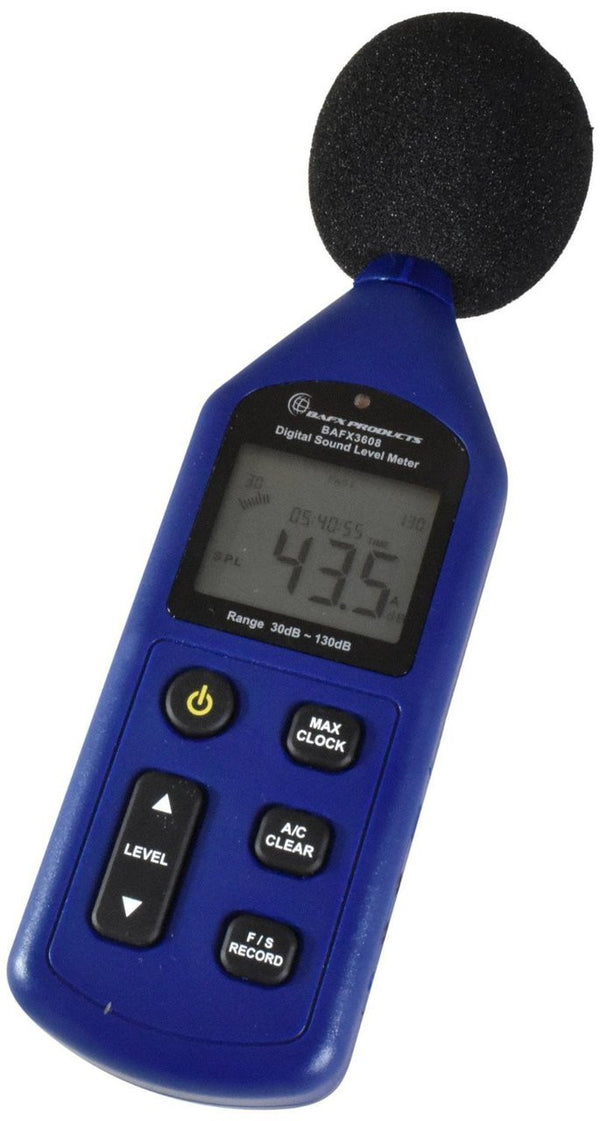
The Amazon bestseller — fine for what it is, know what it isn’t
Search “decibel meter” on Amazon and a BAFX Products listing is reliably near the top — it made the budget decibel meter its own category the way Tavool did for damp meters. Specced at 30–130dB(A) and 35–130dB(C) with ±1.5dB accuracy and MAX hold, it does the fundamentals correctly, and the higher-featured “Advanced” version adds a clock, data-point recording and PC software. Owner feedback is fairly consistent that it’s a plausible, easy-to-read meter for a one-off check.
What you don’t get is a named compliance standard or a guarantee the exact model stays listed under the same name next year — a familiar pattern for this class of import. As a “how loud is this, roughly” tool, it’s genuinely fine.
For
- Widely available and consistently near the top of Amazon’s own search results
- Both A and C weighting, MAX hold, easy LCD readout
Against
- No named compliance standard
- Model naming and exact spec can shift between listings
Typically £25–£40
Check price on AmazonRISEPRO HT-80A Decibel Meter
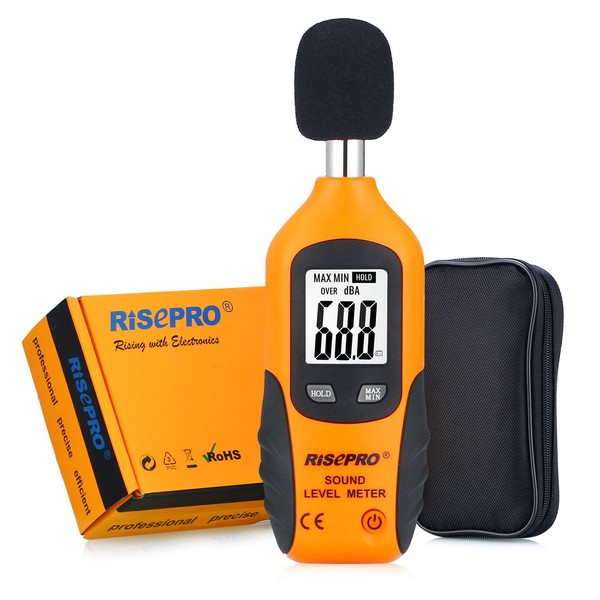
Best budget dual-range — a sensible second meter to leave in the van
The HT-80A covers 30–130dB across two switchable ranges, with ±1.5dB accuracy, backlight, max/min hold and auto power-off — a fuller feature set than its price suggests, supplied with a proper zip carry case rather than nothing. It’s a sensible spare to leave in the van for the days the main meter is charging or on loan.
The frequency range tops out lower than the other meters here (31.5Hz–4kHz against 8kHz), which matters only if you’re chasing high-frequency tonal noise — a whine rather than a rumble. For general room and site checks it’s not a practical limitation.
For
- Dual measurement ranges and a proper carry case included
- Max/min hold and auto power-off at a genuinely low price
Against
- Narrower frequency range than the meters above
- No named compliance standard
Typically £20–£30
Check price on AmazonSilverline 633937 Sound Level Meter

Best on a budget — the honest analogue option
Silverline is a familiar trade name from spirit levels to sack trucks, and this is its take on a sound meter: an analogue needle dial rather than digital, covering 50–126dB with A/C weighting selection and an adjustable slow/fast response dial. There is something to be said for an analogue scale on a fluctuating source — a sweeping needle shows the trend of a reading in a way a digital display refreshing several times a second can obscure. It comes with Silverline’s standard tool guarantee, more reassurance than most budget meters offer.
The narrower range (50–126dB against 30–130dB on the digital meters) means very quiet rooms sit below what it can usefully read. For anything at normal conversational-to-nuisance volume and above, it does the job for the price of a round of drinks.
For
- Cheapest meter here from a proper, guaranteed trade brand
- Analogue needle shows a trend at a glance
Against
- 50–126dB range misses very quiet rooms
- No hold function — you read it live or not at all
Typically £15–£22
Check price on AmazonWhat actually matters — and what doesn’t
A reading is not a nuisance determination. This is the single most important thing on this page. Statutory nuisance under the Environmental Protection Act 1990 isn’t triggered by crossing a fixed decibel number — there isn’t one. An environmental health officer judges nuisance by effect: whether it unreasonably interferes with use and enjoyment of a property, considering time of day, duration, character and locality, using published guideline levels (WHO’s night-noise guidance, BS 8233) as context rather than a threshold. A £20–£150 handheld meter gives a genuinely useful figure for a conversation or a report. It is not, on its own, evidence a council will act on.
Where the evidence trail actually runs. Formal noise-nuisance investigation uses a calibrated, traceable instrument (often Class 1), a protocol that separates background noise from the specific source, and often continuous logging over several nights — usually carried out by the council’s environmental health team or an independent acoustic consultant. If a dispute is heading anywhere formal, a spot reading from any meter here is a starting point for the conversation, not a substitute for that process.
dB(A) is what you want almost always. Unless you’re chasing low-frequency plant hum or bass transmission, leave the meter on A-weighting — switching to C for a general reading just makes the number harder to compare against published guidance.
A windscreen outdoors is not optional. Wind noise across a bare capsule reads as several decibels of nothing. If a garden or roadside reading didn’t come from a meter with one fitted, don’t trust the number.
What the marketing pushes that you can skip. “Professional” on the box means nothing without a named standard behind it. Bluetooth “AI noise analysis” on a £25 meter is decoration on hardware that can’t back it up. Spend the money on the microphone, the windscreen and the weighting instead.
Questions I get asked
What decibel level counts as a noise nuisance? There isn’t a fixed legal number in England and Wales — statutory nuisance is judged on effect, not a threshold, by the local environmental health team. Guideline figures (such as WHO’s roughly 30–35dB LAeq for undisturbed sleep) are useful context, not a line that automatically triggers action. If you’re measuring for your own understanding, compare with and without the noise source in the same conditions rather than chasing an absolute number.
Can I just use a phone app instead of buying a meter? For a rough sense of whether something is loud, yes. Phone microphones are optimised for voice, aren’t weighted or calibrated, and vary wildly between handsets — studies comparing apps against reference meters typically find errors of several decibels either way, with no windscreen. Fine for “is that quieter than before”; not something to hand a neighbour as evidence.
What’s the real difference between dB(A) and dB(C)? A-weighting rolls off low and very high frequencies to mimic human hearing, which is why it’s the standard for nuisance work. C-weighting is close to flat, so it better captures low-frequency content — plant machinery, bass through a party wall, distant traffic rumble — that A-weighting underplays. A meter offering both tells you whether a problem is tonal or a low-end thump, which changes what the fix looks like.
Do I need a calibrated, certified meter for a survey report? Depends what the number is for. An indicative comment — “background road noise was noticeable at the front elevation” — doesn’t need laboratory calibration behind it. A reading that might end up in front of an environmental health officer or a court does, and at that point you’re commissioning a calibrated instrument and a competent acoustic consultant, not buying a meter off this page.
Noise doesn’t usually justify its own instruction, but it turns up inside plenty of others — a building survey or Home Insight Survey noting an environmental risk at the boundary, or a PAS 2035 retrofit assessment where a client wants to know if the new ventilation is actually quieter than the old one — get in touch if that’s the situation you’re in. And if you’re building out a survey bag, there are more field-kit guides, including the lux meter guide this one sits alongside.
Small print. This guide is general information, not an acoustic assessment of your property; a handheld meter reading is indicative only and is not evidence of statutory nuisance. Prices are indicative, move constantly and are checked at the time of writing; the linked page always shows the current price. As an Amazon Associate I earn from qualifying purchases.